

Most people hear "conversational shopping AI" and picture a clunky chatbot that spits out canned responses about shipping times. The reality is far more interesting. Conversational shopping AI, known in the industry as conversational commerce, is a technology that lets you browse, ask questions, get personalized recommendations, and complete purchases entirely through natural language. You talk to it like a person, and it shops with you like a trusted friend who also happens to have the memory of an elephant and the speed of a search engine.
Table of Contents
- Key Takeaways
- What conversational shopping AI really is
- From chatbots to agentic AI: the autonomy spectrum
- The real benefits of conversational shopping
- The infrastructure powering the next wave
- My honest take on where this is all going
- Ready to try AI-powered gift shopping?
- FAQ
Key Takeaways
| Point | Details |
|---|---|
| More than a chatbot | Conversational shopping AI uses NLP and machine learning to understand intent and deliver truly personalized guidance. |
| Three distinct autonomy levels | Basic chatbots, AI shopping assistants, and agentic AI each operate with very different levels of independence. |
| Real business impact | Conversational commerce reduces purchase friction, increases conversion rates, and improves customer satisfaction meaningfully. |
| Agentic shopping is growing fast | AI agents that complete purchases autonomously could represent $385 billion in US ecommerce spending by 2030. |
| Data quality is the hidden key | Clean, structured product catalogs are what separate a fast, accurate AI shopping experience from a frustrating one. |
What conversational shopping AI really is
Think of conversational commerce, the industry's preferred term, as the technology layer that sits between you and a product catalog and speaks your language. Salesforce defines it as AI integrated with chat and voice platforms that facilitates purchases and interactions through natural language rather than keyword-based browsing. So instead of typing "blue running shoes size 10," you say, "I need something comfortable for trail running, I pronate slightly, and my budget is around $120."
What makes this work are two core technologies working in tandem. Natural language processing, or NLP, reads your message and figures out what you actually mean, not just the surface-level words you typed. It picks up on context, intent, and even nuance. Machine learning then takes that understanding further by personalizing recommendations over time, learning your preferences from every interaction and tailoring future suggestions accordingly.
These technologies show up across platforms you already use. The most common delivery mechanisms include:
- Website chat widgets embedded directly in ecommerce stores
- Messaging apps like WhatsApp, Instagram DM, and Facebook Messenger
- Voice assistants like Amazon Alexa, which remembers past purchases and personalizes recommendations based on your history
- In-app AI assistants within mobile shopping applications
The magic is that effective conversational commerce feels like natural human language, never scripted chat. When that line blurs, the shopping experience transforms completely.
From chatbots to agentic AI: the autonomy spectrum
Not all conversational shopping AI is created equal. There is a wide spectrum between a simple FAQ bot and a fully autonomous AI agent, and understanding where each sits helps you appreciate how dramatically this space has evolved.

| Type | Autonomy level | What it can do |
|---|---|---|
| FAQ chatbot | Very low | Answers scripted questions about orders, returns, and shipping |
| AI shopping assistant | Medium | Queries catalogs, filters by preference, makes recommendations, guides checkout |
| Agentic shopping AI | High | Researches products, compares prices, completes purchases with minimal input |
Basic chatbots, as Insider One notes, operate mostly on scripted logic. They are helpful for surface-level support but cannot adapt to nuanced requests or complete transactions. An AI shopping assistant, by contrast, can actually query a product catalog in real time, apply preference filters, and walk you through a purchase. That is a genuinely different experience.
Then there is agentic commerce, and this is where things get genuinely exciting. Agentic shopping AI autonomously completes shopping steps on your behalf, looping back only when it needs your final approval before completing a purchase. Imagine telling an AI, "Find me a birthday gift for my sister who loves yoga and prefers sustainable brands, ship it by Friday," and watching it handle every step. That is agentic commerce in practice.
For agentic shopping to work reliably, two technical ingredients are non-negotiable. First, retailers need clean and structured product catalog data so the AI can match products accurately in real time. Second, checkout APIs need to be accessible and secure so the AI can complete transactions without forcing you back to a browser tab.
Pro Tip: If you are a retailer exploring conversational AI, invest in your product data first. Structured catalogs with consistent attributes, accurate inventory, and rich descriptions are what give any AI assistant the fuel it needs to perform.
The real benefits of conversational shopping
Here is where conversational AI for shopping moves from "cool technology" to something that genuinely changes behavior, for shoppers and for businesses alike.
For shoppers, the most obvious win is personalized product discovery that goes far beyond keyword search. Instead of scrolling through 300 results hoping the algorithm got it right, you get a conversation partner that understands intent and context and narrows the field to exactly what you need. Learning about the benefits of AI gift recommendations shows just how dramatically this changes the experience, especially for emotionally charged purchases like gifts.
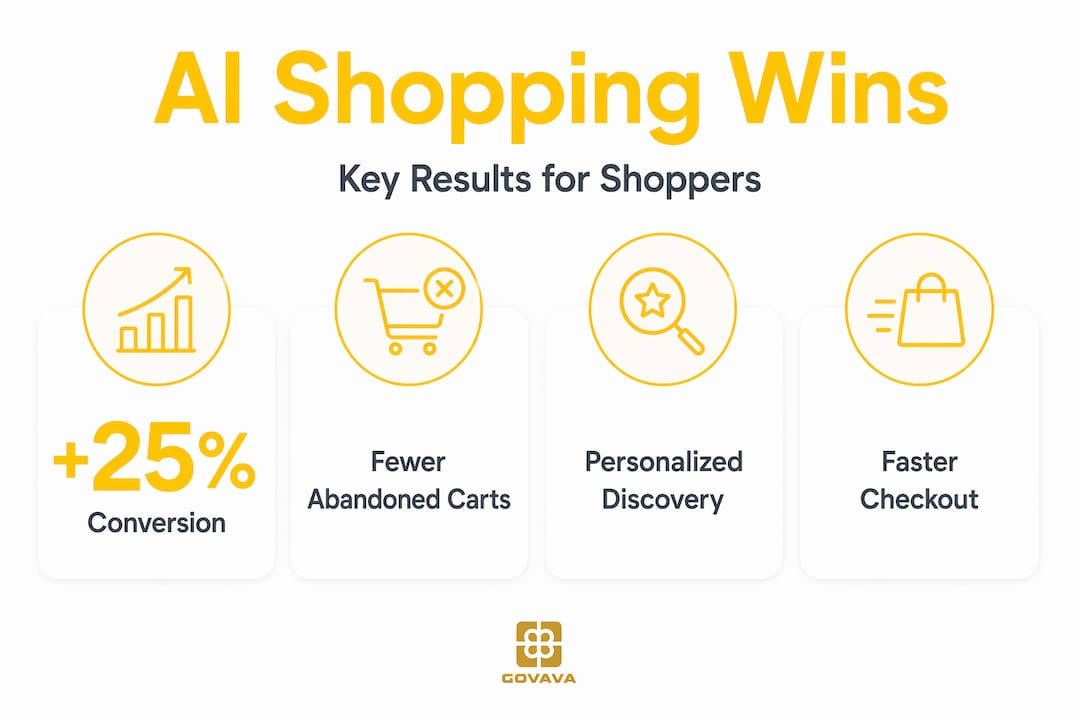
For businesses, the numbers tell a compelling story. Consider what happens when you reduce friction in the purchase journey. The difference between a shopper who abandons a cart and one who completes a purchase often comes down to a single unanswered question. Conversational AI handles that question instantly, at 2 a.m., in three languages, without putting anyone on hold.
The practical benefits break down like this:
- Fewer abandoned carts because the AI addresses hesitation in real time before the shopper leaves the page.
- Higher average order values because the AI can suggest complementary items in a natural, non-pushy way.
- Reduced support costs because conversational AI handles routine queries, freeing human agents for complex situations where empathy and judgment truly matter.
- Stronger customer retention because shoppers who feel understood and guided come back. Conversational commerce drives meaningful personalized connections that translate directly into loyalty.
- Better CSAT scores because the experience feels responsive, personal, and effortless rather than transactional and anonymous.
Stripe projects that agentic commerce could reach $385 billion in US ecommerce spending by 2030, a figure that tells you everything about the direction the industry is heading. Conversational commerce is not a feature anymore. It is becoming the default.
The infrastructure powering the next wave
You might be wondering what holds all of this together behind the scenes. The answer is a fast-evolving ecosystem of protocols, APIs, and data architecture, and 2026 has brought some of the most significant infrastructure developments yet.
Google's Universal Commerce Protocol, or UCP, is one of the most consequential. Google's UCP expansion supports agentic shopping experiences including a Universal Cart that lets shoppers add products from multiple retailers across Google surfaces and complete checkout in one smooth flow. Rather than bouncing between tabs and re-entering payment details at every store, you get a single conversational experience from discovery to confirmation.
The concept that makes this possible technically is the AI-native cart object. Unlike a traditional browser cart tied to one website session, an AI-native cart maintains its state across messages, platforms, and devices. That means your AI assistant can build your cart during your morning commute and you can approve the purchase from your laptop that evening without losing a thing.
Here is a quick look at the key infrastructure components and what they enable:
| Infrastructure component | What it does |
|---|---|
| Universal Commerce Protocol (Google) | Enables cross-retailer discovery and checkout within a single conversational flow |
| AI-native cart objects | Preserve cart state across platforms, sessions, and devices for reliable checkout |
| Delegated payment authorization | Allows AI agents to initiate transactions securely on user behalf |
| Structured product catalog APIs | Feed real-time inventory and attributes to AI for accurate, fast matching |
The Universal Cart integrates discovery, cart management, and checkout into one secure flow rather than the traditional separate funnels most shoppers wrestle with today. It is a genuinely different architecture, and it signals where the whole industry is headed.
One important caveat: the AI is only as good as the data it works with. Clean, consistent product catalogs are what make real-time AI matching accurate and fast. Retailers with inconsistent data, missing attributes, or stale inventory will find their AI underperforming no matter how sophisticated the model is.
Pro Tip: Conversational AI agents split their memory into short-term session data and long-term preference profiles to balance personalization with speed. If an AI assistant seems to "forget" you between sessions, that is usually a sign the long-term memory layer is not configured properly.
My honest take on where this is all going
I've watched enough technology trends arrive with enormous fanfare and then quietly underperform to be skeptical of anything labeled "the future of shopping." But after spending considerable time with conversational shopping AI, I genuinely believe the skeptics are wrong on this one.
What I've noticed is that the gap between promise and reality usually comes down to data, not the AI itself. Retailers pour resources into choosing a model and building a chat interface, then neglect the product catalog that feeds it. The AI ends up recommending out-of-stock items or missing obvious matches because the underlying data is a mess. Fix the data, and the AI looks like a genius.
I've also seen AI-powered personalized shopping perform best when it embraces emotional context, not just transactional context. Knowing someone's shoe size is useful. Knowing they are buying a gift for a grieving friend and need something warm and personal is transformational. That is where tools like Govava are doing something genuinely different, by bringing emotional and relational intelligence into the recommendation layer.
My practical advice: if you are a shopper, lean into these tools rather than treating them with suspicion. The more context you give them, the better they perform. And if you are a retailer or builder in this space, stop treating conversational AI as a customer service band-aid. It is a discovery and conversion engine, and the businesses that treat it that way will pull ahead quickly.
Privacy is the legitimate concern here, and it deserves more attention than it gets. Long-term preference profiles are powerful, but shoppers deserve clear control over what is remembered and what is not. The platforms that get this right will earn the kind of trust that drives retention.
— carl
Ready to try AI-powered gift shopping?
Understanding conversational shopping AI is one thing. Experiencing it is something else entirely. Govava was built on exactly this premise: that the best shopping experiences feel like a conversation with someone who genuinely knows you.

Whether you are shopping for a birthday, an anniversary, or a "just because" moment, Govava's AI gift wizard takes the guesswork out of the equation by matching gifts to personality, lifestyle, and relationship context. You describe the person you are shopping for, and the AI does the heavy lifting. You can also explore personalized gift ideas right now and see the recommendations for yourself. No endless scrolling. No second-guessing. Just gifts that actually land.
FAQ
What is conversational shopping AI in simple terms?
Conversational shopping AI, also called conversational commerce, lets you shop through natural conversation rather than keyword searches. It uses NLP and machine learning to understand what you want and recommend products that genuinely match your needs.
How does shopping AI work to personalize recommendations?
The AI reads your input using NLP to interpret intent, then applies machine learning to match products based on your preferences and past behavior. Over time it learns what you like and surfaces more relevant results with each interaction.
Is conversational shopping effective for businesses?
Yes. Conversational commerce reduces cart abandonment, increases conversion rates, and improves customer satisfaction by handling queries instantly and personalizing the purchase journey at scale.
What is agentic commerce and how is it different?
Agentic commerce takes conversational shopping AI one step further by letting the AI autonomously research, compare, and complete purchases on your behalf, checking in only for final approval before the transaction goes through.
What examples of shopping AI exist today?
Amazon Alexa for Shopping is one well-known example, personalizing recommendations based on purchase history and ongoing conversations. Google's Universal Commerce Protocol and AI gift platforms like Govava represent newer, more sophisticated applications of the same technology.