

There's a widely held belief that AI gift recommendations are about as personal as a generic gift card stuffed in an envelope. Cold. Mechanical. Utterly clueless about the emotional dynamics of your family. But that picture is badly out of date. Today's AI gifting systems don't just scan a wish list; they read the room, factoring in relationship dynamics, emotional cues, personality traits, and even the quirky details that make your family uniquely yours. If you've ever stood frozen in a store aisle, wondering what on earth to buy your hard-to-please father-in-law or your teenager who "has everything," this article is your guide to understanding how AI has quietly become one of the most thoughtful gifting tools available to parents.
Table of Contents
- The science behind AI and relationship-driven gifting
- Emotional intelligence: how AI detects sentiment and context
- Tailoring gifts: Inputs that drive true personalization
- Overcoming edge cases: heterophily, new recipients, and practical challenges
- Our take: The real secret to scaling family intimacy with AI
- Make your next family occasion unforgettable with AI-powered gifting
- Frequently asked questions
Key Takeaways
| Point | Details |
|---|---|
| Relationship modeling | AI uses graph neural networks to understand and account for social and family relationships in gifting. |
| Emotional intelligence | Emotion-aware models enrich recommendations for family occasions by factoring sentiment and nuance. |
| Practical personalization | You control personalization with inputs like relationship type, occasion, and budget for tailored family gifts. |
| Managing challenges | AI systems handle tricky cases like unfamiliar recipients and contrasting personalities using advanced methods. |
| Scaling intimacy | AI blends data and emotional context to create gifts that feel handpicked, deepening family connections. |
The science behind AI and relationship-driven gifting
Having challenged common views about AI's emotional limitations, let's see how advanced systems actually model relationships for effective gifting.
At the heart of modern AI gifting wizardry is a technology called graph neural networks, or GNNs. Think of a GNN like a social map where every person, product, and interaction is a dot (a "node"), and every relationship or shared experience is a line connecting those dots (an "edge"). This map allows AI to understand not just who you are, but who you're connected to and how those connections shape what a meaningful gift might look like. According to research from Kumo AI, AI accounts for recipient relationships in personalization primarily through GNNs in recommender systems, modeling users and items as nodes with edges representing interactions, social connections, and relationships.
Why does this matter for your family's birthdays and anniversaries? Because the connection between you and your mom is fundamentally different from the connection between you and your best friend, and a smart AI system knows that. GNNs can trace a path that says, "this was recommended because a family member enjoyed something similar," which creates recommendations that feel curated and warm, not random. Research confirms that GNNs outperform matrix factorization for relational data, enabling explainable recommendation paths that feel surprisingly human.
The numbers back this up convincingly. Graphs can provide up to 4x better accuracy (measured by MAP@K, a standard ranking metric) compared to non-graph methods when relational data is involved. For parents who care deeply about getting the gift "just right," that accuracy gap isn't just a statistic; it's the difference between a gift that lands perfectly and one that gets a polite smile. An AI gift wizard overview that taps into this kind of relational intelligence can feel almost telepathic. Pair that with retail AI personalization advances, and you start to see how a tailored shopping journey becomes genuinely possible for every family member on your list.
| Method | Handles relational data | Explainable paths | Relative accuracy |
|---|---|---|---|
| Matrix factorization | Limited | No | Baseline |
| Graph neural networks (GNNs) | Excellent | Yes | Up to 4x higher |
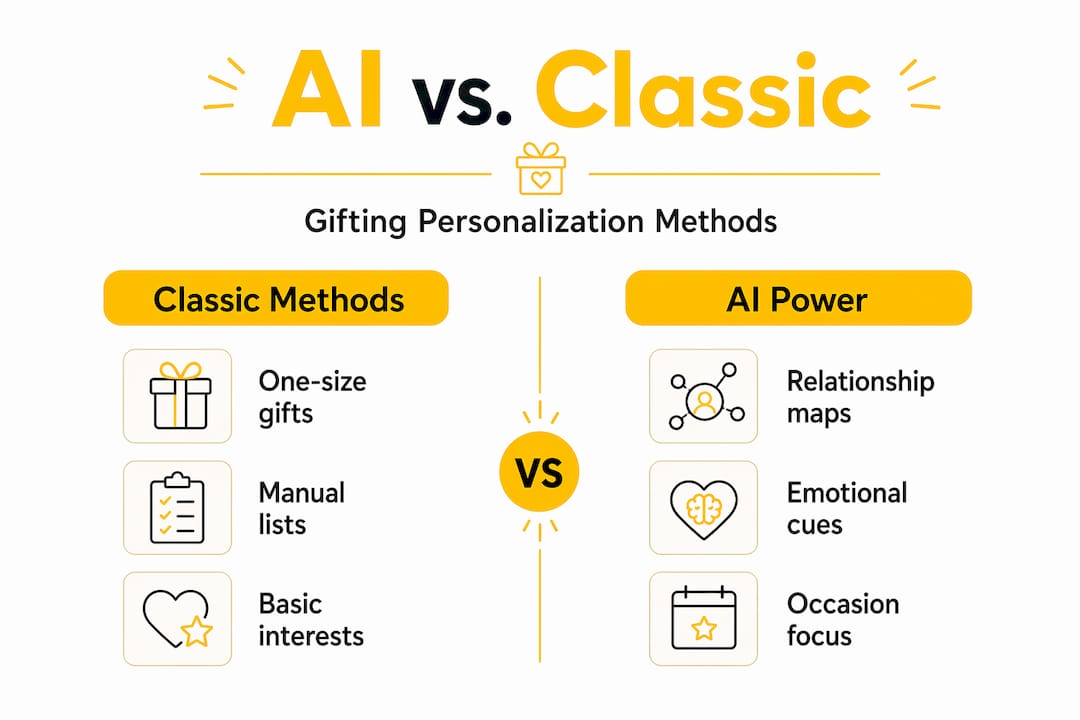
It's worth noting that personalized content impact research consistently shows that relevance is the single biggest driver of satisfaction, and GNNs are purpose-built for relevance at a relational level.
Emotional intelligence: how AI detects sentiment and context
Once relationships are modeled, AI goes deeper by factoring in emotion, analyzing sentiments to optimize gifting for emotional resonance.
Here's where things get genuinely fascinating. Imagine AI not just as a search engine, but as a really attentive friend who reads between the lines. Modern emotion-aware AI models do exactly that. They extract sentiment and nuanced emotional signals from reviews, past interactions, and behavioral data to build a richer picture of what a recipient truly enjoys. Emotion-aware models like ESE-DT extract sentiment and emotions from reviews to enrich user embeddings, improving recommendations by 11.76% nDCG@10 on Yelp for contextually relevant suggestions suitable for family occasions.

An 11.76% lift sounds modest on paper, but in real-world gifting terms that's a substantial jump in how often a recommendation feels genuinely fitting rather than just plausible. For a parent shopping for AI recommendations for families, this kind of contextual accuracy is gold. It means the AI isn't just matching "Dad likes sports" to a generic sports product; it's picking up on whether he's enthusiastic about attending live games versus watching at home, or whether he's more of a collector than an active participant.
The emotional cues AI systems use are more varied than most people expect. They include written review tone and word choice, star ratings combined with review text, browsing behavior patterns, past purchase history, and wishlisted items the recipient never bought. When you weave all of these signals together, as emotional context in AI research demonstrates, AI and human intuition start to dance together in a surprisingly effective way.
| Emotional signal | What AI learns | Example application |
|---|---|---|
| Review sentiment | Genuine enthusiasm vs. polite acceptance | Avoids "safe" gifts that underwhelm |
| Browsing patterns | Active curiosity around specific categories | Surfaces niche products recipient explores |
| Wishlist behavior | Desired but delayed purchases | Recommends items with high personal value |
| Purchase history | Repeated preferences and evolving tastes | Builds accurate personality profile over time |
Pro Tip: Don't limit your AI inputs to broad identity categories like "mom" or "teenager." The more you share about what your recipient genuinely enjoys doing on a Saturday afternoon, the more emotionally resonant the suggestion becomes. Interests and lived experiences beat demographic labels every single time.
Tailoring gifts: Inputs that drive true personalization
Knowing how emotional and relationship modeling works, let's walk through the practical ways parents drive the personalization process.
Picture this: you sit down to find a birthday gift for your twelve-year-old's best friend, a kid you know reasonably well but not deeply. Where do you even start? This is exactly the scenario AI gifting tools were built for. According to research, AI tools input relationship type along with recipient profile, occasion, and budget to generate tailored suggestions emphasizing emotional connections. The more context you feed in, the sharper and more satisfying the output becomes.
Here's how the process typically flows for a parent:
- Define the relationship. You tell the AI whether this is for a child, a spouse, a parent, an in-law, or a close friend. Each category carries different emotional weight and different gift conventions, and the AI adjusts accordingly.
- Set the occasion. Birthday, anniversary, graduation, holiday, or just because. The occasion shapes the tone entirely. An AI for special occasions recommendation for Valentine's Day looks very different from one for a housewarming, even for the same recipient.
- Sketch the recipient's personality and interests. Outdoorsy? Foodie? Tech-obsessed? A homebody who loves cozy nights in? These details are where the real magic kicks in.
- Set a realistic budget. This narrows the field without sacrificing quality. AI doesn't just filter by price; it finds options that feel premium within your range.
- Review and refine. Most platforms let you give feedback on early suggestions, and the AI recalibrates. It's an evolving conversation, not a one-shot answer.
Research from Apify shows that gift AI analyzes social profiles for interests and personality, factoring in occasion and budget for family-appropriate recommendations. Combined with thoughtful giftee management, you can keep a running profile for every person you shop for, so the AI gets smarter about your family over time. If you're hunting for an AI for birthday gifts for a teenager, that evolving profile is particularly valuable as their tastes shift rapidly.
Understanding your buyer persona creation for each recipient is essentially what AI does automatically. It builds a miniature persona and shops from that perspective.
"The most meaningful gifts don't feel purchased. They feel noticed. AI gifting platforms are getting extraordinarily good at operationalizing that feeling, blending behavioral data and relationship context until the suggestion feels less like an algorithm and more like a wise friend who's been paying close attention."
Pro Tip: When you specify the occasion type with precision, you'll see dramatically better results. "Birthday" is good. "40th birthday for someone who recently took up hiking" is great. The extra detail transforms a generic recommendation into something that genuinely stops the recipient in their tracks.
Overcoming edge cases: heterophily, new recipients, and practical challenges
But real families present real challenges. Here's how AI manages tricky situations like new giftees or very different personalities.
Every family has at least one person who defies easy categorization. Maybe it's the uncle who is simultaneously a hardcore heavy metal fan and an avid knitter. Or your new daughter-in-law you've met exactly twice. These are the situations that make gift shopping genuinely stressful, and they're also the situations where most people assume AI falls completely flat. Surprisingly, it doesn't.
The concept of heterophily describes connected users who are very different from each other. Think of it as the opposite of the "birds of a feather" assumption. Most AI models assume that connected people share tastes, but that's not always true in families. Research confirms that heterophily is handled by specialized GNNs and cold-start scenarios for new recipients are mitigated by social connections or profile inputs. This means AI can recognize when a recipient is genuinely different from the people around them and adjust recommendations accordingly, rather than defaulting to what everyone else liked.
The cold-start problem refers to situations where little or no data exists about a recipient. A new giftee, a recently blended family member, a colleague you've just gotten to know. AI systems handle this by leaning on broader social graph signals, using what similar users enjoy and weighting that against the sparse profile data available. You can accelerate this by providing even basic details through an AI search for gifting platform.
Practical tips for parents navigating these edge cases include sharing at least three specific interests for any new giftee, noting any strong dislikes (this negative signal is surprisingly powerful), specifying the nature of your relationship honestly rather than generically, and updating the recipient's profile after each occasion with a quick note on how the gift was received. Retail AI case studies consistently show that this kind of iterative feedback loop dramatically improves accuracy over multiple gifting cycles.
Our take: The real secret to scaling family intimacy with AI
With core mechanics explained, here's our editorial take on what really makes relationship-driven AI gifting effective for families.
Most gifting guides stop at identity matching. They say, "she likes yoga, so buy yoga gear." That's fine advice, but it misses the deeper layer entirely. The real magic of AI gifting isn't in matching labels to products. It's in recognizing what a person enjoys about an experience and finding gifts that honor that enjoyment in a fresh way. A person who loves yoga might equally love a beautifully designed journal, a niche wellness subscription, or a handcrafted tea set, because what they're really drawn to is slowness, intentionality, and self-care. A label-matching system gives them another yoga mat. An emotionally intelligent AI gives them something that makes them feel genuinely known.
We've noticed that parents, in particular, tend to underestimate how much their own emotional investment shapes the gifting process. When you share context with an AI platform about why this occasion matters, not just the facts but the feeling, you're essentially giving the system permission to go deeper. Relationship-based AI gifting works best when it's treated as a collaboration, not a vending machine.
The uncomfortable truth is that most gifting stress comes from a fear of being seen as someone who didn't care enough. AI doesn't eliminate that fear by choosing randomly. It reduces it by operationalizing the thoughtfulness you already feel, channeling your emotional investment into algorithmic precision that surfaces gifts with genuine resonance. Data-driven emotional gifting research supports this: when emotional context is baked into the recommendation engine, recipients report feeling more seen and appreciated by the giver, even without knowing AI was involved.
That, more than any technical feature, is the real promise of this technology for families.
Make your next family occasion unforgettable with AI-powered gifting
Ready to apply these insights? Here are solutions designed to help parents find the perfect gift, every time.
You've just seen how much intelligence goes into a truly personalized gift recommendation, from graph neural networks tracing family relationship paths to emotion-aware models picking up on subtle sentiment signals. Now imagine having all of that working for you in a matter of seconds, not hours of scrolling.
Govava's AI gift wizard does exactly this, blending behavioral insights, relationship context, and emotional intelligence to surface gifts that feel handpicked rather than algorithmically generated. You can browse personalized gift products curated for every family occasion and personality type, and if you want to weigh your options before committing, you can easily compare gift options side by side. Whether you're shopping for a milestone birthday, a holiday, or one of those "just because" moments that matter most, Govava is your trusty sidekick for gifting that actually means something.
Frequently asked questions
How does AI personalize gifts for different family members?
AI analyzes relationship type, occasion, and interests alongside emotional sentiment to recommend gifts that feel thoughtfully chosen rather than generic. The result is a suggestion that reflects both who the recipient is and the nature of your relationship with them.
What happens if the recipient is new or there's little information?
AI uses social connections or basic profile inputs to fill gaps, helping even in cold-start situations where a giftee is new or has minimal data available. Providing even a handful of specific interests accelerates accuracy considerably.
Can AI really capture emotional connections for gifting?
Emotion-aware models extract sentiment and context from user interactions, improving gift relevance for family occasions by over 11% in controlled studies. Emotional nuance is baked into the system, not bolted on as an afterthought.
How does AI handle very different personalities in a family?
AI applies specialized GNNs for heterophily, meaning it can recognize and account for dissimilar users within the same family network. You won't get a recommendation based on what everyone else liked if your recipient marches to their own drum.
Is inputting occasion and budget important for gift recommendation?
Absolutely. Factoring in occasion and budget gives AI the critical context it needs to surface family-appropriate, emotionally fitting suggestions within a practical range. Think of them as the guardrails that keep recommendations genuinely useful.