

Shopping for your whole family's birthdays, holidays, and special occasions is a genuinely tall order. One kid is obsessed with dinosaurs, another lives for soccer, your partner just picked up birdwatching, and your mom wants "something thoughtful." Most parents assume AI gift tools just recycle vague suggestions based on browsing history, but that picture is wildly incomplete. Modern AI uses a layered combination of behavioral signals, personality inputs, and family profiles to generate recommendations that feel almost eerily accurate. This article walks you through exactly how that magic works, so you can get the most out of every gifting occasion.
Table of Contents
- From profiles to personalization: How AI distinguishes family member interests
- How behavioral data powers personalized gift ideas
- The power and pitfalls of parent-supplied details
- Combining AI signals for perfect, occasion-ready presents
- What can go wrong: Shared accounts and interest mix-ups
- What most parents miss about AI-powered gifting
- Take your gifting game further with AI tools
- Frequently asked questions
Key Takeaways
| Point | Details |
|---|---|
| Separate profiles matter | Distinct accounts for each family member lead to more relevant and meaningful gift ideas. |
| Parent input supercharges AI | Your detailed knowledge bridges gaps that behavioral data alone cannot fill for new or nuanced interests. |
| Mixing methods yields best results | Combining ongoing behavioral data with recent parent-supplied info helps AI adapt to special occasions and new interests. |
| Avoid shared account pitfalls | Not separating family data leads to confusing, generic recommendations, especially for gifts. |
| Review and update regularly | Refreshing profiles and described interests keeps your family's AI recommendations on point for every new event. |
From profiles to personalization: How AI distinguishes family member interests
Now that you see the promise, let's break down the specific ways AI learns and adapts to your whole family's unique interests.
The foundation of any good AI gifting system is the ability to tell one person apart from another. Without that separation, AI is essentially throwing darts in the dark. The good news is that most platforms have built elegant solutions for this. Understanding how AI gift wizards work starts with a surprisingly simple idea: each family member needs their own behavioral home base.
When platforms like Netflix or Amazon Family give every member their own profile, something valuable happens. Each person's clicks, views, purchases, and time spent browsing accumulate into a unique behavioral fingerprint. That fingerprint is what the AI reads when generating recommendations. The more someone interacts under their own profile, the sharper and more personalized the suggestions become over time.
Here is a quick look at how the two main personalization methods compare:
| Method | How it works | Best for | Weakness |
|---|---|---|---|
| Separate user profiles | Tracks each member's behavior independently | Ongoing, adaptive gifting | Requires consistent separate usage |
| Parent-supplied inputs | You describe the recipient directly to the AI | New members, one-time occasions | Only as good as what you share |
| Hybrid approach | Combines behavioral data with your descriptions | Special occasions, full family | Needs regular updates to stay sharp |
When you mix shared accounts without profiles, interests blur together and recommendations start to feel oddly random. Imagine asking for birthday gift ideas for your eight-year-old and getting suggestions clearly aimed at an adult who loves home renovation podcasts. That is exactly what happens when behavioral data gets tangled. Keeping profiles clean and separate is the single most impactful habit you can build as a family-oriented shopper.
Pro Tip: Before the next major gift-giving season, spend five minutes setting up individual profiles for each family member on your go-to shopping or streaming platforms. It is the simplest thing you can do to dramatically improve AI recommendation accuracy.
How behavioral data powers personalized gift ideas
With clear profiles, AI can begin to leverage the goldmine of behavioral data your family generates daily.

Every click, every product page lingered on, every abandoned cart and completed purchase teaches AI something specific. It is not just noting "this person bought a book." It is registering which book, which genre, how long they spent reading the description, and whether they came back to look at it again. Multiply that across weeks and months, and a remarkably detailed portrait of a person's taste emerges.
What makes this genuinely impressive is the science underneath it. Netflix's personalization models use collaborative filtering combined with deep learning to generate what researchers call "embeddings." Think of embeddings as a kind of personality map in math form, where people with similar tastes cluster together and the AI can predict what someone will love even before they find it themselves. Each profile generates its own unique map, which is why keeping profiles separate is so critical.
There is another layer here called semantic labeling, and it is worth knowing about. Platforms like Bytek use natural language processing and topic modeling to analyze behavioral clusters and assign human-readable interest labels with relevance scores. In practical terms, that means AI might tag your teenager as a "sneakerhead," your partner as a "wellness enthusiast," and your youngest as a "science kit lover." Those labels then guide behavior-driven gift products toward the right recipient with striking accuracy.
Here is how behavioral AI builds its recommendations in sequence:
- Data collection: Every interaction is recorded under the correct profile.
- Pattern analysis: AI scores and ranks behaviors by frequency and recency.
- Cluster comparison: Your profile is compared to millions of similar users through collaborative filtering.
- Semantic labeling: Interest categories are assigned based on those behavioral clusters.
- Occasion matching: Labels are filtered against the occasion (birthday, holiday, graduation) to surface relevant ideas.
"The difference between a generic suggestion and a genuinely thoughtful gift often comes down to one thing: how cleanly the AI can read one person's interests without noise from others."
Even pet gift recommendations benefit from this approach. If your family includes a devoted pet owner whose profile reflects frequent searches for animal care products, the AI recognizes that pattern and factors it into occasion-based suggestions. Behavioral data, when clean and profile-specific, is genuinely one of the most powerful gifting tools available to parents today.
The power and pitfalls of parent-supplied details
While AI can learn a lot from behavior, your knowledge as a parent supercharges the process.
Here is the honest truth: behavioral data takes time to build. A new family member, a recently developed hobby, a kid who just discovered a passion for robotics — these things do not show up in behavioral histories overnight. That is exactly where your voice as a parent becomes the secret weapon. When you describe someone to an AI tool directly, you bypass the cold-start problem entirely.
Amazon Rufus is a great example of how this works in practice. When a parent tells Rufus something like "I have a five-year-old who is wild about dinosaurs and an eight-year-old who plays travel soccer," the AI immediately uses that context to filter its entire product universe. It factors in age-appropriateness, interest alignment, and budget sensitivity to surface suggestions that feel hand-picked rather than algorithmically assembled.
Generative AI tools like Meta AI and similar platforms take this even further. They use natural language processing to interpret your description, match it against known interest patterns, and generate tailored ideas on the spot. The richer your description, the better the output. Saying "my husband likes fitness" yields decent results. Saying "my husband just started trail running, loves minimalist gear, and has a birthday in two weeks" yields remarkable ones.
There are a few common traps worth avoiding here:
- Vague descriptions ("she likes crafts") produce predictably generic suggestions. Get specific about materials, skill levels, and favorite themes.
- Outdated information leads AI to recommend things your family member has outgrown or lost interest in. A child who loved slime kits at seven may now be all about coding at ten.
- Missing the occasion context means AI defaults to general interest-matching instead of something occasion-perfect. Always mention whether it is a birthday, graduation, or holiday.
Pro Tip: Think of briefing an AI tool like briefing a really attentive personal shopper. The more you tell them, the more delighted you are by what they bring back. If you are planning for the holidays, start building your descriptions months ahead and refine them as interests evolve. And for a finishing touch on any occasion, layering in a beautifully curated gift box alongside an AI-recommended item adds a warm, personal dimension no algorithm can replicate.
Combining AI signals for perfect, occasion-ready presents
By merging both types of insights, parents can unlock truly individualized gift inspiration for every family event.
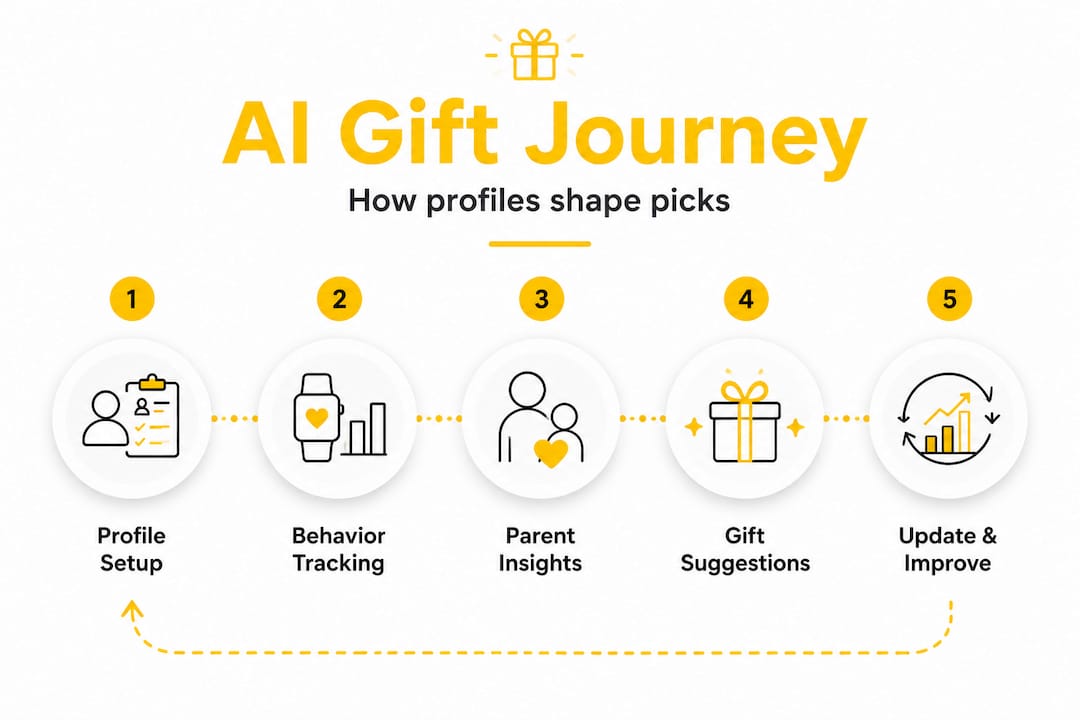
The most powerful gifting experiences happen when behavioral intelligence and parent-supplied context work side by side. Neither method alone is as effective as the two together. Behavioral data tells AI who a person is based on their patterns. Your direct input tells AI who they are becoming right now, especially around milestones like turning thirteen, heading off to college, or finally committing to a new hobby.
Meta AI's gifting features explicitly recommend this combined approach. You describe your family dynamics and the AI layers that over your shopping history to generate nuanced recommendations. The result is something that feels genuinely thoughtful rather than statistically probable. Picture getting birthday gift ideas for your son that perfectly land because the AI knew about his behavioral patterns and the fact that he just made the school baseball team.
There are a few habits that make the hybrid approach sing:
- Refresh your descriptions before every major occasion. Interests shift, especially in kids. What felt accurate in January might be stale by December.
- Note life milestones in your profile inputs. Starting a new sport, passing a driving test, or getting into a new school all open up fresh gifting categories.
- Match your tone to the occasion. A graduation gift needs a different frame than a "just because" birthday present, and telling the AI which one you are shopping for sharpens its output immediately.
- Layer in regional context when it matters. If you are shopping for someone rooted in a specific place or culture, mentioning it can lead to locally inspired gift ideas that carry extra emotional weight.
Pro Tip: Treat your AI gifting tool like a living document, not a one-time query. Every time you update a family member's profile or re-describe their interests before a big event, you are investing in better recommendations for every occasion that follows.
What can go wrong: Shared accounts and interest mix-ups
Despite its strengths, AI-powered gifting systems have pitfalls, especially if you skip this one critical setup step.
Imagine searching for the perfect gift for your twelve-year-old and getting suggestions clearly meant for someone who binge-watches home improvement shows and shops for power tools. Funny? Yes. Helpful? Not remotely. This is the very real consequence of shared accounts without individual profiles, where adult and child behavioral data gets scrambled into a confusing mix that makes AI recommendations unreliable at best and hilariously off at worst.
Interest contamination is the technical term for this, and it is more common than most parents realize. When four family members browse under one account, the AI cannot distinguish your teenager's gaming obsession from your partner's cookbook habit. The result is recommendations that serve no one particularly well.
Here is how to keep things clean:
- Create a separate, named profile for every family member, including young children.
- Label kids' profiles clearly so AI recognizes the appropriate age range and content tier.
- Avoid cross-using profiles, even occasionally. One session of crossover can muddying a well-trained profile.
- Periodically review profile activity to catch any mix-ups early.
A smart gift search powered by clean, individual data will always outperform one drawing from a tangled shared pool. Treating profile hygiene as a regular habit, rather than a one-time setup, is what separates parents who consistently find great gifts from those who remain perpetually stuck in the "I never know what to get them" cycle.
What most parents miss about AI-powered gifting
Having seen the how, let us look at what most parents overlook, and how you can do better with a few simple habits.
Most parents still approach AI gifting tools the same way they approach a vending machine: put in a basic request, press a button, and hope for the best. The problem is that AI is not a vending machine. It is closer to a brilliant personal shopper who gets sharper the more you communicate with them and duller the more you leave them guessing.
The most effective parents using AI for holiday shopping do two things consistently: they input rich, specific details about each family member, and they update those details regularly. Knowing that your daughter loved science kits last year but now cannot stop talking about graphic novels is exactly the kind of intelligence that transforms a good recommendation into a jaw-dropping one.
What most parents miss is the idea that AI rewards consistency and specificity. Five minutes of thoughtful input before a major gifting occasion is worth more than hours of aimless scrolling. Revisiting your family member profiles before every birthday, holiday, or milestone is the single habit that understanding gift wizards absolutely depends on for accuracy. AI does not get lazy when you update it. It gets better. And that is an investment worth making every single time.
Take your gifting game further with AI tools
You now know how AI reads behavioral data, how your descriptions unlock precision, and how keeping profiles clean makes everything sharper. Putting that knowledge to work is the exciting part.

Govava is built exactly for moments like these. As an AI gift wizard designed around personality, lifestyle, and emotional context, Govava takes everything you have learned here and makes it effortless. You can browse personalized gift products curated by AI across every occasion and interest category, and you can organize your giftee list so every family member's preferences are saved, updated, and ready to go when the next celebration rolls around. No more guessing, no more generic suggestions. Just thoughtful, meaningful gifts that actually land.
Frequently asked questions
How do I make AI gift suggestions more accurate for my family?
Provide detailed, specific information about each family member's age, interests, personality, and recent changes, and update that information before every major occasion. Amazon Rufus shows that richly described family details like ages and hobbies produce far more relevant, age-appropriate recommendations.
Do all platforms let me create separate profiles for each family member?
Most major services support individual profiles, and using them prevents recommendations from blending together into a confusing mix. Separate profile creation allows each family member to build an independent behavioral history that drives accurate, personalized results.
Why do gift suggestions sometimes seem generic or wrong?
Generic suggestions almost always trace back to shared or incomplete profiles where multiple people's interests have gotten mixed together, reducing the AI's ability to personalize. Shared accounts without profiles are the single biggest cause of this, and individual profiles fix it directly.
How does AI learn new interests after a big life event or hobby change?
AI adapts quickly when you enter updated descriptions or when new behaviors are recorded consistently under the correct profile. Meta AI's gifting tools recommend combining your direct input with platform history for the most nuanced results after any major life change.
Is there a best method for discovering interests of new family members with no history?
Yes, directly inputting their details and interests into an AI tool is the fastest path to meaningful suggestions when no behavioral history exists yet. Amazon Rufus specifically excels at this cold-start scenario, using parent-supplied context to bypass the behavioral data gap entirely.