

AI personality analysis is defined as the process of extracting behavioral and linguistic patterns from communication data to predict psychological traits that inform personalized decisions. In the context of gift-giving, this means AI can read between the lines of how someone texts, emails, or interacts online to build a surprisingly accurate picture of who they are. Models trained on frameworks like the Big Five personality traits, MBTI, and the Enneagram now power platforms that go far beyond "what's their favorite color." Understanding how AI understands recipient personality is the key to unlocking gift recommendations that genuinely feel personal, not just algorithmically convenient.
How AI understands recipient personality through behavioral cues
The raw material AI uses to infer personality is not a questionnaire. It is the unfiltered record of how a person communicates. Word choice, sentence length, emotional tone, and even the rhythm of a message all carry personality signals that AI models are trained to detect and interpret.
Verbal cues are the most data-rich signal available. A person who writes in long, complex sentences with precise vocabulary tends to score higher on the Big Five trait of Openness. Someone who uses short, direct sentences with action-oriented language often registers higher on Conscientiousness. AI systems that analyze voice and style profiles from sent message history capture greeting choices, sentence rhythm, vocabulary, and structure across 200 to 500 emails per recipient, building a behavioral fingerprint that no single survey could replicate.

Paraverbal cues add another layer. Pacing, formality, and the presence or absence of humor in written exchanges tell AI a great deal about social style. A person who opens every message with a warm, personal check-in before getting to the point signals Agreeableness. Someone who skips pleasantries and leads with the task at hand signals a different profile entirely. These patterns accumulate over time, and that accumulation matters enormously.
Research from ETH Zurich found that AI predicts Big Five traits with up to 61% accuracy when trained on user chat history, analyzing over 62,000 interactions from 668 participants. More interaction data directly improves prediction accuracy, which means the longer someone uses a platform, the sharper the personality portrait becomes.
Pro Tip: If you want AI-powered gift recommendations to feel truly personal, use a platform that learns from ongoing interaction rather than a one-time quiz. The more context the AI has, the more precise its suggestions become.
Behavioral signatures like greeting style, bullet list preference, and emoji frequency are more precise personality indicators than traditional self-assessment questionnaires. This is a genuinely counterintuitive finding. People often describe themselves inaccurately on surveys, either because of social desirability bias or simple lack of self-awareness. Behavioral data does not lie in the same way.
How do AI models combine multiple personality frameworks?
Single-framework personality assessments have a well-known weakness: they flatten a complex human being into one set of labels. The Big Five tells you someone is high in Extraversion, but it does not tell you how that Extraversion interacts with their attachment style or their Enneagram drive for security. AI changes this by synthesizing multiple frameworks simultaneously.
Here is how single-framework quizzes compare to AI-powered multi-framework assessments:
| Approach | Method | Output |
|---|---|---|
| Single-framework quiz (e.g., MBTI only) | Static, self-reported questions | One-dimensional type label |
| AI multi-framework analysis | Adaptive conversational assessment | Layered portrait with tensions and blind spots |
| Behavioral data modeling | Pattern matching across interaction history | Dynamic, evolving trait prediction |
Tools like the AI Personality Analyzer by Jenova synthesize Big Five, MBTI, Enneagram, and attachment theory into a unified, multi-dimensional personality portrait. Rather than running isolated quizzes, the system conducts adaptive conversational assessments that identify convergences, tensions, and blind spots across frameworks. This is the difference between a snapshot and a full portrait.
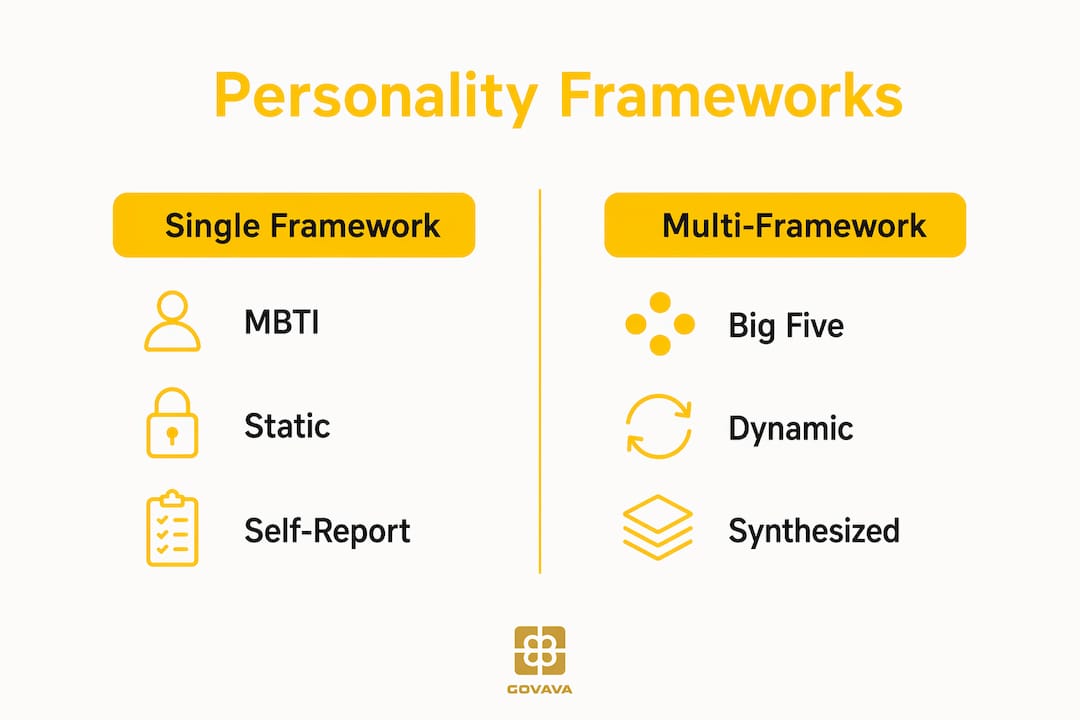
The practical gift-giving implication is significant. Knowing someone is an INTJ on the MBTI tells you they value competence and independence. Layering in their Big Five Openness score tells you whether they prefer novel experiences or refined versions of things they already love. Adding Enneagram context reveals whether their independence comes from a desire for mastery or a fear of vulnerability. Each layer sharpens the gift recommendation from "something thoughtful" to "exactly this."
Optimal AI personality analysis synthesizes multiple psychological models concurrently, offering dimensional and dynamic insights that single-framework assessments simply cannot match. For gift-givers, this means the AI is not guessing. It is triangulating.
Pro Tip: When using an AI gifting tool, look for one that asks follow-up questions rather than presenting a fixed list. Adaptive questioning is the hallmark of multi-framework analysis, and it produces far more accurate gift matches.
What are the current limits of AI personality interpretation?
AI personality analysis is genuinely impressive, but it is not magic. There are real boundaries to what current systems can do, and understanding those limits helps you use AI tools more wisely rather than blindly.
The most significant challenge is what researchers call the alignment gap. AI shows only a 0.26 correlation with human judgment when interpreting subtle social cues, while humans achieve correlations above 0.79. AI relies heavily on visible pattern matching rather than the kind of inverse planning humans use to infer mental states. In plain terms, AI can read what someone says but often misses what they mean beneath the surface.
Several specific limitations are worth keeping in mind:
- Nonverbal signals are invisible to text-based AI. Crossed arms, avoidant posture, and micro-expressions carry enormous emotional weight in human interaction. AI systems that struggle with low-energy social signals miss the emotional subtext that a perceptive human friend would catch immediately.
- Short interactions produce weak predictions. The 61% accuracy figure from ETH Zurich requires substantial interaction history. A brief exchange or a single form submission gives AI very little to work with.
- Privacy is a genuine trade-off. Greater data access leads to higher accuracy, but privacy-preserving approaches recommend local data processing to limit centralized profiling. More data means better gifts but also more exposure.
- Self-reported data introduces bias. When AI relies on what users say about themselves rather than behavioral patterns, the accuracy drops because people consistently overestimate or underestimate their own traits.
Human judgment remains a meaningful complement to AI analysis, especially in sensitive gifting contexts like grief, illness, or major life transitions. AI is your trusty sidekick in the gift-giving process, not the final authority.
How does AI personality insight actually improve gift-giving?
Picture this: you need a birthday gift for your sister. You know she is creative and loves travel, but beyond that, you are stuck. An AI gifting platform that has analyzed her communication patterns knows she uses vivid, sensory language, responds enthusiastically to novelty, and tends to prioritize experiences over objects. That is not a guess. That is a personality-informed recommendation.
Here is how AI-driven personality insights translate into better gifting outcomes, step by step:
- Trait inference from behavioral data. AI analyzes communication history to predict where a recipient falls on dimensions like Openness, Agreeableness, and Conscientiousness. A high-Openness person is more likely to love an unusual experience gift than a practical household item.
- Emotional resonance matching. Personality-adaptive AI agents infer user personality in real time and adapt along dimensions like warmth, brevity, and formality. In gifting, this means the AI can predict whether a recipient values sentimental meaning or functional utility more highly.
- Dynamic adaptation over time. AI does not lock in a profile after one interaction. As more data accumulates, the portrait evolves. A platform that learns recipient preferences over multiple gifting occasions becomes progressively more accurate with each recommendation.
- Friction reduction for busy shoppers. The average person spends significant time and mental energy on gift selection, often defaulting to generic choices out of exhaustion. AI reduces that friction by narrowing thousands of options to a curated shortlist based on the recipient's actual personality profile.
- Contextual occasion matching. Generative AI categorizes social interactions into structured taxonomies based on conflict, power, and duty variables, analyzing 20,000 interactions to map behavioral patterns. This means AI can factor in not just who someone is, but what the occasion calls for emotionally.
The result is a gift that lands. Not just something wrapped nicely, but something that makes the recipient feel genuinely seen. That is the real promise of AI-matched gifts for personality-based recommendations.
Key takeaways
AI understands recipient personality by combining behavioral data, multi-framework psychological models, and dynamic adaptation to produce gift recommendations that reflect who someone actually is, not just what they say they like.
| Point | Details |
|---|---|
| Behavioral data beats self-reports | Communication patterns like word choice and greeting style predict personality more accurately than questionnaires. |
| Multi-framework analysis adds depth | Combining Big Five, MBTI, and Enneagram produces richer, more nuanced personality portraits for gifting. |
| More interaction means better accuracy | AI trained on 62,000+ chat interactions achieves up to 61% Big Five prediction accuracy. |
| The alignment gap is real | AI correlates only 0.26 with human judgment on subtle social cues, so human context still matters. |
| Dynamic adaptation improves over time | AI personality profiles evolve with each interaction, making recommendations sharper with every occasion. |
Why I think we are only scratching the surface here
I have spent a lot of time watching AI personality tools evolve, and the honest truth is that most people still underestimate what is actually happening under the hood. The common assumption is that AI reads a few data points and spits out a generic profile. The reality is far more interesting and, frankly, more useful than that.
What strikes me most is the finding that building rapport is less about matching a user's entire personality and more about dynamically adjusting stylistic dimensions like tone warmth and brevity. This reframes the whole conversation. AI is not trying to clone a personality. It is learning how to respond to one, which is a much more socially intelligent task.
The part that deserves more attention is the privacy trade-off. People want hyper-personalized recommendations, but they are often uncomfortable with the data collection that makes those recommendations possible. The solution is not to abandon personalization. It is to demand platforms that process data locally and transparently. That is a conversation the gifting industry needs to have more openly.
My honest take: AI personality analysis for gifting is already good enough to be genuinely useful, and it is improving faster than most people realize. The gap is not in the technology. It is in how well platforms communicate what they are doing with your data and why it makes the experience better. Use these tools, but stay curious about how they work.
— carl
Find the perfect gift with Govava's AI gift wizard
Govava is built on exactly the kind of personality-driven intelligence this article describes. Its AI analyzes recipient traits, behavioral cues, and occasion context to surface gift ideas that actually fit the person you are shopping for, not just the category they belong to.
Whether you are shopping for a birthday, anniversary, or a last-minute occasion, Govava's AI gift search tool narrows thousands of options to a curated shortlist in seconds. No more scrolling through endless product pages hoping something clicks. You describe who you are shopping for, and Govava's personality-matching engine does the rest. Try it and see how much easier thoughtful gifting can be.
FAQ
What data does AI use to analyze recipient personality?
AI analyzes communication patterns including word choice, sentence structure, emotional tone, and interaction history. Behavioral signatures like greeting style and vocabulary complexity are more accurate personality indicators than self-reported questionnaires.
How accurate is AI at predicting personality traits?
AI models trained on chat history can predict Big Five personality traits with up to 61% accuracy, based on a study of over 62,000 interactions. Accuracy improves significantly as more interaction data becomes available.
Can AI understand emotions as well as humans do?
Not yet. AI shows only a 0.26 correlation with human judgment on subtle social cues, compared to human correlations above 0.79. AI misses nonverbal signals like body language and emotional subtext that humans interpret naturally.
Does AI use more than one personality framework?
Yes. Advanced AI personality tools synthesize multiple frameworks including the Big Five, MBTI, Enneagram, and attachment theory simultaneously, producing multi-dimensional profiles that single-framework quizzes cannot replicate.
Is my personal data safe when AI analyzes my personality?
Privacy depends on the platform. Privacy-preserving approaches recommend local data processing to limit centralized profiling, so it is worth checking how any AI gifting tool stores and uses your communication data before engaging with it.