

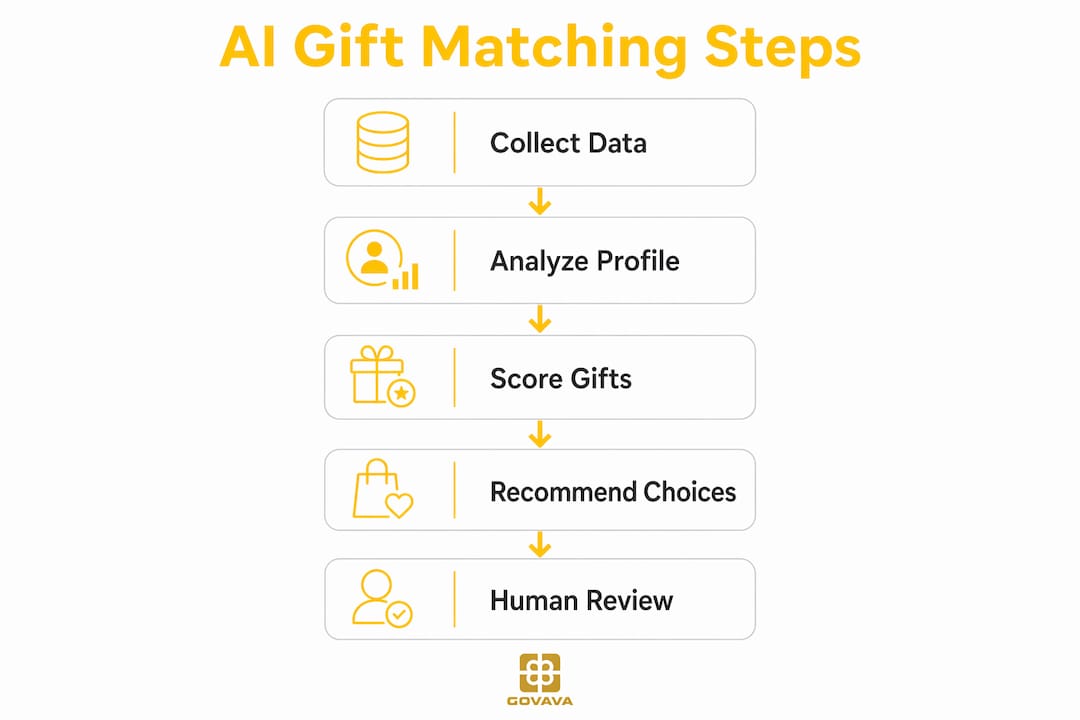
AI gift matching is the process of using artificial intelligence to analyze recipient information, behavioral signals, and occasion context to recommend personalized gifts quickly and accurately. Think of it as having a brilliant personal shopper who never forgets a detail, never runs out of ideas, and somehow knows your sister would absolutely love that artisan candle set. The technology behind this gift-giving wizardry follows a three-step pipeline: data gathering, gift matching and scoring, and learning from feedback. Platforms like Govava, along with tools referenced in research from Imprint Engine, Alhena AI, and The Gift Whisperer project, all rely on this same foundational architecture. The result is AI-powered gift suggestions that feel personal, arrive on time, and actually make people smile.
How AI gift matching works: collecting the right data first
Before any algorithm can recommend the perfect birthday gift, it needs to understand who it's shopping for. AI gift matching systems gather recipient information through several distinct channels, and the quality of that input directly determines the quality of the output.
The most common starting point is a structured quiz or conversational dialog. You answer questions about the recipient's hobbies, age, relationship to you, budget, and the occasion. Some platforms use conversational AI that builds a detailed recipient profile through natural back-and-forth dialogue, much like texting a very well-organized friend who happens to know every product on the internet. This approach captures nuance that a simple dropdown menu never could, like the fact that your dad is technically a "golfer" but really only plays twice a year and mostly enjoys the post-round beer.

Beyond explicit input, AI systems also read behavioral signals. Browsing history, clicked products, items added to a cart, and even abandoned carts all tell the system something meaningful about preferences. These signals are especially powerful because they reflect actual behavior rather than what someone says they like. An AI gift finder that tracks which categories a user lingers on can infer taste with surprising accuracy.
For corporate gifting scenarios, platforms integrate with CRM tools like Salesforce and HubSpot to automate recipient data syncing and reduce manual input entirely. LinkedIn profiles and past interaction records feed into recipient profiles, giving the AI rich context about professional relationships and communication styles. Natural language processing then converts all that free-form text into structured data fields the matching engine can actually use.
- Explicit inputs: Quizzes, conversational dialogs, stated preferences, and occasion details
- Behavioral signals: Browsing patterns, click data, cart activity, and past purchase history
- External data: CRM records, social media signals, and professional profile information
- Structured profiling: NLP converts free text descriptions into clean, matchable data fields
Pro Tip: Give the AI as much specific detail as you comfortably can. "She likes fitness" is useful. "She runs half-marathons and recently started cold-water swimming" is gold. The more precise your input, the more precise the recommendation.
What algorithms actually do when matching gifts
Here is where the real gift-giving wizardry happens. Once the AI has a recipient profile, it does not simply search a catalog and return the first ten results. The matching process is layered, combining multiple algorithmic approaches to produce recommendations that feel genuinely thoughtful.
The process typically unfolds in stages:
- Candidate generation: The system queries a product catalog across multiple price tiers simultaneously, pulling a broad pool of potentially relevant gifts. Generating candidates per price tier in parallel is critical because single-prompt generation tends to cluster results around middle-budget options, leaving budget-conscious and luxury shoppers underserved.
- Rule-based filtering: Hard constraints are applied first. Budget ceiling, delivery deadline, occasion type, and relationship context eliminate unsuitable candidates before any scoring begins.
- Machine learning re-ranking: A machine learning model then re-orders the filtered candidates based on behavioral data and past feedback. This is where hybrid matching systems shine, combining collaborative filtering (what similar people liked), content similarity (how well product attributes match the profile), and knowledge graph reasoning (structured relationship data between concepts like "runner" and "hydration gear").
- Meta-ranking and fusion: A final meta-ranker fuses all these signals into one score. Advanced systems use knowledge graph path evidence to justify why a specific gift was recommended, which improves both user trust and system transparency.
- Narrative packaging: The best platforms do not just surface a product. They attach a short story or provenance note explaining why this gift fits, transforming accurate matches into emotionally coherent gestures rather than cold algorithmic outputs.
Pro Tip: Layered matching improves both relevance and interpretability. If a platform can explain why it recommended something, that is a sign the system is using structured reasoning rather than guesswork.
The difference between a basic recommendation engine and a sophisticated gift matching algorithm is the ability to balance multiple competing signals at once, budget versus desirability, novelty versus safety, personal taste versus occasion norms, and still land on something that feels right.
Why human oversight still matters in AI gift matching
AI is sharp as a tack when it comes to pattern recognition, but it does not yet have the full emotional intelligence of a thoughtful human being. That is not a flaw in the technology. It is simply an honest acknowledgment of where automation and human judgment each add the most value.
Human review steps are especially important in sensitive gifting contexts. A corporate gift for a recently bereaved colleague, a first anniversary present for a new relationship, or a graduation gift for someone navigating a difficult family situation all require a layer of contextual awareness that pure algorithmic scoring can miss. Humans catch what the data cannot fully encode: cultural nuance, recent life events, and the subtle difference between a funny gift and an accidentally offensive one.
Real-time checks add another layer of practical intelligence to the process:
- Delivery feasibility: The AI checks whether a gift can actually arrive on time, and warns or restricts options if the delivery window is too tight.
- Inventory verification: Live catalog integration confirms that a recommended product is actually in stock before it surfaces as a suggestion.
- Personalization options: The system checks whether gift wrapping, custom engraving, or a personal message card is available for a given item.
- Feedback loops: When a recipient swaps a gift, ignores a recommendation, or enthusiastically accepts it, the AI takes notes and adjusts future scoring accordingly.
Mature AI gift matching platforms treat human oversight not as a workaround for AI limitations but as a deliberate design choice. The goal is a system where AI handles the speed and scale, and humans add the judgment and warmth. Together, they produce recommendations that feel less like a database query and more like a genuinely thoughtful suggestion from someone who knows you well. Govava is built on exactly this philosophy, pairing algorithmic precision with the kind of emotional intelligence that makes gifting feel personal.
Common challenges and how to get better results
Even the most sophisticated gift matching AI is only as good as the information it receives. Understanding where these systems can stumble helps you use them more effectively.
Ambiguous or thin recipient descriptions are the most common source of weak recommendations. "He likes sports and tech" describes roughly 40% of adult men and gives the algorithm very little to work with. The more specific and layered your description, the better the output. Think about recent life changes, specific hobbies, things the person has mentioned wanting, or experiences they have talked about. That level of detail is what separates a generic gift from one that genuinely lands.
Budget management is another area where users sometimes trip up. If you enter a budget range that is too wide, the algorithm may default to middle-tier options and miss both the affordable gems and the premium picks that would actually impress. Narrowing your range or specifying a target spend gives the system cleaner constraints to work with.
A few practical tips for getting the most from AI gift matching tools:
- Be specific about the occasion. "Birthday" and "milestone 50th birthday" produce very different recommendation sets.
- Describe the relationship context. A gift for a close friend differs from one for a work colleague you respect but do not know well.
- Mention what has not worked before. If the recipient already owns every kitchen gadget known to humanity, say so.
- Use the feedback options. When a platform lets you rate or swap recommendations, use it. That feedback directly improves the next round of suggestions.
Pro Tip: If recommendations feel generic, try rephrasing your recipient description using specific verbs rather than adjectives. "She trains for triathlons every morning" tells the AI more than "she's athletic."
Understanding AI-powered personalized shopping at a deeper level also helps you recognize when a platform is genuinely sophisticated versus when it is just running a keyword search dressed up with a chatbot interface.
Key takeaways
AI gift matching works best when structured data collection, layered algorithmic scoring, and human oversight operate together as a unified system rather than separate steps.
| Point | Details |
|---|---|
| Three-step pipeline | Every AI gift matching system collects data, scores candidates, and learns from feedback to improve over time. |
| Layered algorithms | Hybrid systems combining rule-based filters, ML re-ranking, and knowledge graphs produce more relevant and explainable recommendations. |
| Human oversight is non-negotiable | AI handles speed and scale, but human review catches cultural nuance and emotional context that algorithms miss. |
| Input quality drives output quality | Specific, detailed recipient descriptions consistently produce better gift matches than vague or generic inputs. |
| Feedback loops matter | Rating or swapping recommendations trains the system and measurably improves future suggestions for the same recipient. |
My honest take on where AI gifting is headed
I have spent a lot of time thinking about the intersection of technology and human connection, and AI gift matching sits right at that fascinating crossroads. Here is what I genuinely believe: the platforms that will win long-term are not the ones with the most sophisticated algorithms. They are the ones that understand when to let the AI lead and when to step back and let human judgment take over.
The next wave of gift matching AI will be deeply conversational. Instead of filling out a form, you will describe a person the way you would to a trusted friend, and the system will ask smart follow-up questions to fill in the gaps. Contextual understanding will improve dramatically, with AI recognizing not just what someone likes but what they need right now, based on life stage, recent events, and emotional context.
What concerns me is the risk of over-engineering the emotional side. Narrative packaging and provenance notes are genuinely powerful when done well, but they can feel hollow and manipulative when they are clearly templated. Authenticity is the hardest thing to automate, and the platforms that try too hard to fake it will lose user trust fast.
Data privacy is the other challenge nobody talks about enough. The more personal information these systems collect, the more powerful their recommendations become. But users deserve transparency about what data is stored, how it is used, and who has access to it. The best AI gift platforms will make that transparency a feature, not a footnote.
Understanding how AI gift matching works is not just a technical curiosity. It genuinely empowers you to use these tools better, ask smarter questions, and recognize when a recommendation is truly personalized versus when it is just a well-dressed guess.
— carl
Discover smarter gifting with Govava
If you have ever stared at a blank search bar wondering what on earth to buy someone, Govava was built for exactly that moment. Govava's AI gift matching platform combines recipient profiling, real-time product recommendations, and personalized occasion context to surface gifts that actually mean something.
Whether you are shopping for a milestone birthday, a last-minute anniversary, or a thoughtful corporate gesture, Govava's AI gift wizard does the heavy lifting. The platform integrates behavioral signals with explicit preferences, applies layered matching algorithms, and includes human-in-the-loop safeguards to keep every recommendation appropriate and on point. Explore Govava's curated gift catalog and let the AI find something genuinely worth giving.
FAQ
What is AI gift matching?
AI gift matching is the use of artificial intelligence to analyze recipient data, behavioral signals, and occasion context to recommend personalized gifts. The process follows a three-step pipeline of data gathering, algorithmic scoring, and feedback-based learning.
How does the AI know what gift to recommend?
The AI builds a recipient profile from quiz inputs, browsing behavior, and contextual data, then applies layered algorithms including rule-based filters, machine learning re-ranking, and knowledge graph reasoning to score and rank candidates. The highest-scoring options surface as recommendations.
Can AI gift matching handle different budgets?
Yes. Well-designed systems generate candidates across multiple price tiers in parallel to avoid clustering around middle-budget options, which means you get relevant suggestions whether your budget is $25 or $250.
Is human review part of AI gift matching?
Human oversight is a deliberate feature in mature AI gift matching platforms, not a fallback. Humans review recommendations for cultural sensitivity, emotional appropriateness, and contextual fit, especially in complex or sensitive gifting situations.
How can I get better recommendations from an AI gift tool?
Provide specific, detailed descriptions of the recipient rather than broad adjectives. Mention the exact occasion, the relationship context, and any gifts that have not worked in the past. Using feedback options within the platform also trains the system to improve future suggestions.