

An AI gift finder is an intelligent recommendation tool that generates personalized gift ideas based on the recipient's interests, relationship to the buyer, occasion, and budget. Think of it as having a sharp, thoughtful shopping companion who actually listens when you describe the person you're shopping for, then swoops in like a superhero clad in binary code to hand you exactly the right options. Platforms like Govava, along with retail tools from Kohl's and Kate Spade, have made this kind of AI-driven gift discovery a genuine part of how people shop in 2026. The result is less scrolling, less second-guessing, and a lot more confidence at checkout.
What is an AI gift finder, exactly?
An AI gift finder is defined as a software tool that uses natural language understanding and machine learning to match a buyer with relevant, purchasable gifts for a specific recipient. Unlike a generic "top 10 gifts for mom" listicle, it generates personalized gift lists by processing recipient-specific inputs: who they are, what they love, what the occasion is, and how much you want to spend. The industry term for the broader category is conversational commerce, and AI gift finders are its most emotionally intelligent application.
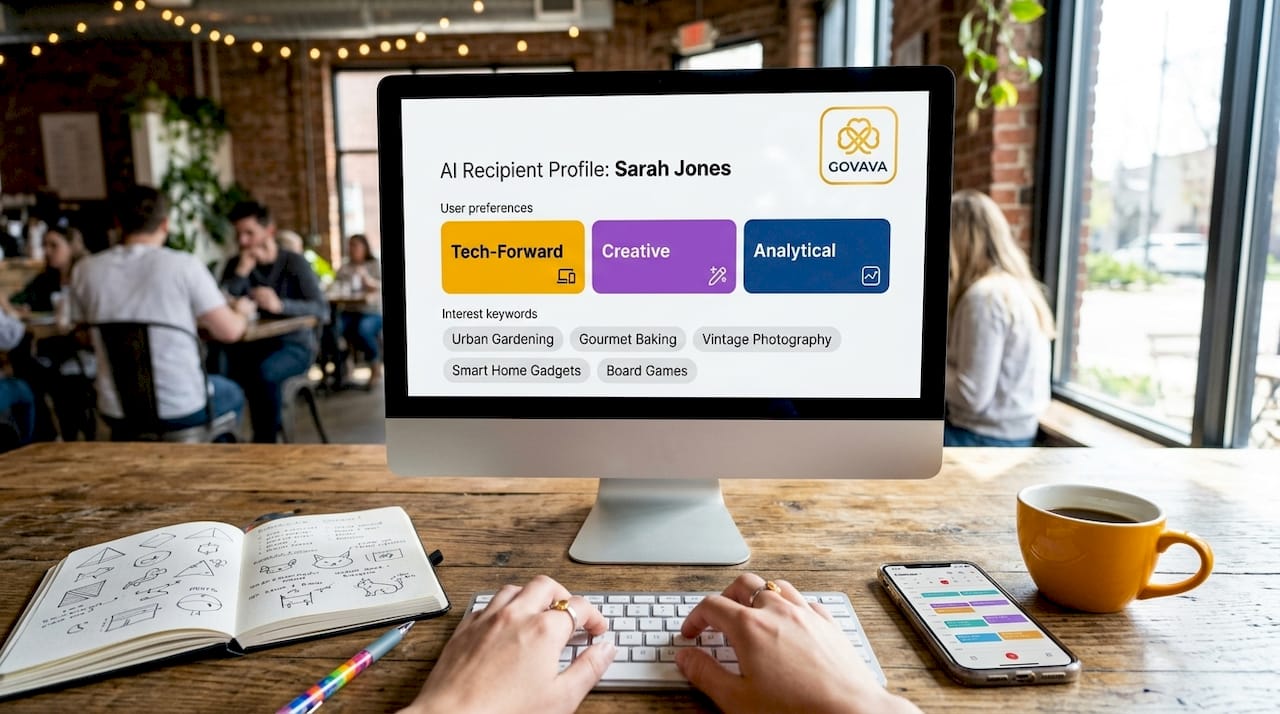
The core function is recipient profiling. You describe your person, and the AI takes notes with algorithmic precision, cross-referencing those details against a real-time product catalog to surface options that actually make sense. Jenova's Shopping Advisor, for example, personalizes suggestions based on age, personality, interests, budget, and occasion, eliminating hours of browsing in a single conversation. That shift from passive browsing to active, guided discovery is what separates AI gift finders from everything that came before them.
How does an AI gift finder work?
The magic starts with a single sentence from you. Conversational AI gift finders extract relationship, interests, and personality cues from free-text input and recommend gifts across multiple categories simultaneously. You type something like "my sister is turning 30, she loves hiking and wellness, budget around $80," and the AI parses every signal in that sentence: the relationship, the age milestone, the lifestyle interests, the price ceiling.
Here is what happens under the hood, step by step:
- Recipient profiling: The AI identifies who the gift is for, their personality traits, hobbies, and lifestyle from your natural language description.
- Occasion and context mapping: It registers the event type (birthday, anniversary, graduation) and adjusts the tone and category of suggestions accordingly.
- Budget calibration: Price sensitivity is factored in from the start, so recommendations stay realistic and purchasable.
- Catalog grounding: Suggestions are matched against real, in-stock products rather than hypothetical ideas, keeping every option actionable.
- Follow-up refinement: You can push back, ask for something more unique or less expensive, and the AI adjusts in real time.
Tools like Alhena AI and Jenova use this conversational model to capture multiple layers of intent from a single input, which is something a static filter or a dropdown menu simply cannot do. A dropdown asks you to pick a category. A conversational AI asks you to describe a person. The difference in output quality is enormous.
Pro Tip: When you first describe the recipient, include at least one personality trait alongside their interests. "She's introverted and loves yoga" produces far more curated results than "she likes yoga" alone.
How AI gift finders compare to traditional methods
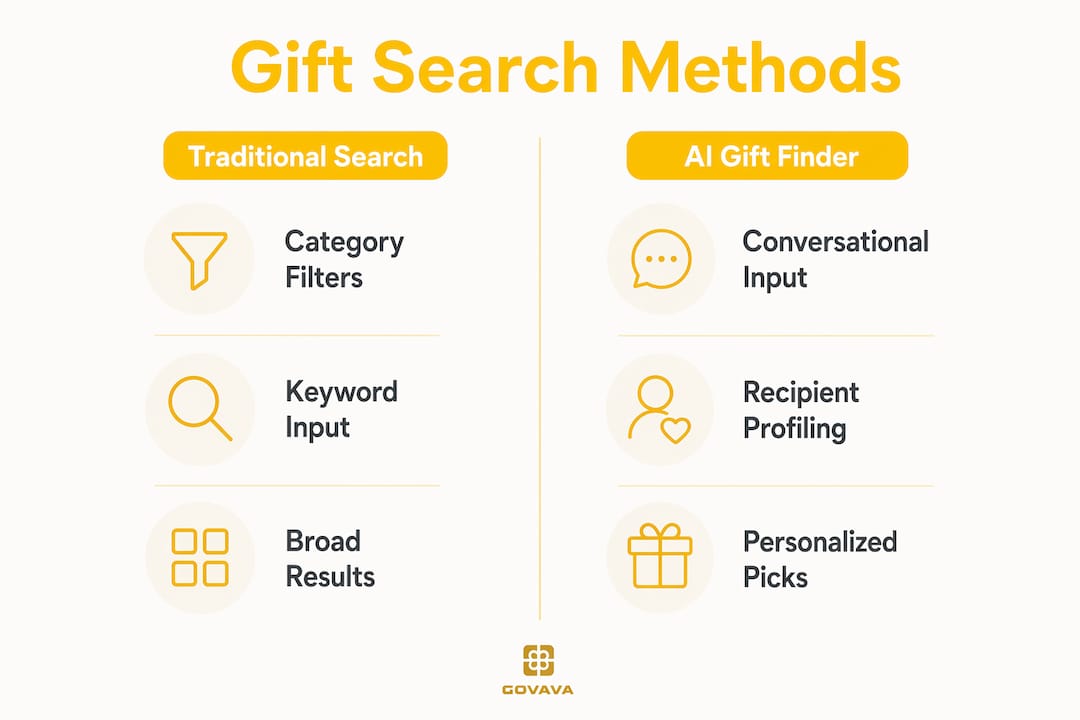
Picture this: you open a major retailer's website and click "Gifts for Her." You get 4,000 results, sorted by popularity, with no idea whether any of them suit the actual human you're shopping for. That is the traditional method, and it puts all the cognitive work on you.
AI gift finders flip that dynamic entirely. The comparison below shows where the real differences land.
| Feature | Traditional gift search | AI gift finder |
|---|---|---|
| Input method | Category filters, keywords | Natural language conversation |
| Personalization | Generic by gender or age | Recipient-specific by interests and occasion |
| Product matching | Static catalog browsing | Real-time catalog grounding |
| Refinement | Manual re-filtering | Conversational follow-up prompts |
| Conversion rate | Baseline keyword search | Up to 3.5× higher conversion |
| Proxy expertise | None | Ingredient explanations, fit guidance, product context |
Kate Spade's AI Gift Concierge achieved that 3.5× conversion rate improvement over keyword search by guiding shoppers through a conversation shaped by past behaviors and recipient context. That number is not a rounding error. It reflects a fundamental truth: when shoppers feel understood, they buy with confidence.
The limitations are real, though. AI quality depends entirely on the signals you provide and the depth of the product catalog behind the tool. A poorly described recipient produces generic suggestions, and an AI grounded in a thin catalog will recycle the same few products. The role of AI in modern shopping is powerful, but it is only as good as the inputs and inventory it works with.
How AI gift finders connect to shopping and checkout
The best AI gift finders do not stop at suggestions. They walk you all the way to the cart. This is what the industry calls agentic commerce: a conversation that leads directly to adding products, selecting gift wrapping, entering a delivery date, and completing a purchase, all without leaving the chat interface.
Kohl's launched a conversational AI agent that integrates image uploads and in-chat browsing with purchasing actions, letting shoppers discover and buy gifts without switching screens. That reduction in friction at the search-to-buy handoff is where conversion gains are actually won. Every extra click between "I love this" and "I bought this" is a chance for a shopper to abandon the process.
Here is what tight commerce integration looks like in practice:
- Image upload: Upload a photo of something the recipient owns or loves, and the AI finds similar products in the catalog.
- In-chat browsing: Scroll through product cards, read reviews, and compare options without leaving the conversation.
- One-click cart addition: Add a recommended item directly from the chat, with size, color, or variant selection handled in the same thread.
- Gift presentation options: Select gift wrapping, add a personalized message card, and schedule delivery timing, all within the AI interface.
- Persistent memory: The best tools remember past purchases and preferences so you never accidentally repeat a gift.
Pro Tip: If an AI gift finder offers image upload, use it. Uploading a photo of the recipient's home decor style or a brand they already wear gives the AI a richer signal than text alone, and the suggestions get noticeably sharper.
Grounding AI suggestions in real, purchasable inventory is what separates a genuinely useful tool from a creative brainstorming exercise. Suggestions that cannot be bought are just ideas. Suggestions tied to actual products with delivery dates are gifts.
Tips for getting the most from an AI gift finder
Getting great results from an AI gift finder is less about the technology and more about the quality of what you bring to the conversation. The AI is sharp, but it works best when you give it something to work with.
- Describe the recipient in full. Include their relationship to you, age range, personality type, top three interests, and any hobbies they are currently obsessed with. The more specific you are, the more relevant AI recommendations become.
- State your budget clearly and early. Do not wait for the AI to ask. Saying "$60 to $100" upfront keeps every suggestion realistic and saves you from falling in love with something out of range.
- Use follow-up prompts to refine. If the first round of suggestions feels too safe or too niche, say so. Ask for something more experiential, more luxurious, or more practical. Conversational AI is built for this kind of back-and-forth.
- Look for tools with persistent memory. If you shop for the same people every year, a tool that remembers previous gifts prevents awkward repeats. Govava's Giftee List feature is designed exactly for this.
- Validate with product context. The best AI gift finders offer proxy expertise with verified product data, including fit guidance, ingredient explanations, and compatibility notes. Read those details before adding to cart.
- Try social profile scanning if available. Tools like Apify's AI gift system can analyze public social media profiles to extract interests and generate tailored ideas with purchase links in under five minutes, which is genuinely useful when you know very little about the recipient.
Real-world AI gift finders worth knowing about
The AI gift finder space has grown quickly, and several platforms now offer meaningfully different approaches to the same core problem.
| Platform | Approach | Standout feature |
|---|---|---|
| Govava | Conversational AI with recipient profiling | Occasion awareness, persistent giftee memory |
| Kohl's AI Agent | Agentic commerce with in-chat purchasing | Image upload, cart integration |
| Kate Spade AI Concierge | Behavior-informed conversational discovery | 3.5× conversion vs. keyword search |
| Jenova Shopping Advisor | Natural language recipient description | Instant curated ideas, no browsing required |
| Apify AI Gift Engine | Social media profile analysis | OpenAI or Google Gemini-powered, under 5 minutes |
Each platform reflects a different philosophy. Kohl's and Kate Spade embed AI inside existing retail experiences to reduce friction for shoppers already on their sites. Jenova and Govava function as standalone gifting companions, prioritizing depth of personalization over catalog breadth. Apify's approach is the most technically adventurous, using public profile data to infer preferences without the buyer needing to describe the recipient at all.
The emerging trend for 2026 is convergence: platforms are combining conversational profiling, agentic checkout, and persistent memory into single experiences. The benefits of personalized gift discovery are no longer theoretical. They are measurable in conversion rates, time saved, and the look on someone's face when they open exactly the right thing.
Key takeaways
AI gift finders work best when you combine detailed recipient input with a platform that grounds suggestions in real, purchasable inventory and integrates directly with checkout.
| Point | Details |
|---|---|
| Core definition | An AI gift finder recommends personalized gifts using recipient interests, occasion, relationship, and budget. |
| Conversational advantage | Chat-based tools capture multiple intent signals from one input, outperforming static filters and keyword search. |
| Commerce integration | Agentic AI tools connect recommendations directly to cart and checkout, reducing friction and increasing conversions. |
| Input quality matters | More specific recipient details produce sharper, more relevant suggestions from any AI gift finder. |
| Real-world results | Kate Spade's AI Concierge achieved 3.5× higher conversion than keyword search through guided conversational discovery. |
Why AI gift finders changed how I think about gifting
I will be honest: I was skeptical the first time I tried an AI gift finder. It felt like outsourcing something that was supposed to be personal. But after describing my brother to one of these tools, including his obsession with cold-brew coffee and his recent move into a new apartment, and receiving three genuinely spot-on suggestions within seconds, I changed my mind fast.
What struck me most was not the speed. It was that the AI encouraged me to think more carefully about the recipient than I usually do. The act of describing someone forces you to actually consider who they are, what they value, and what would make them feel seen. The AI does not replace that thoughtfulness. It amplifies it.
That said, I have noticed real limitations. Tools without deep catalog grounding tend to recycle the same safe suggestions: candles, wine, gift cards. The conversational interface is only as good as the inventory behind it. And tools that lack persistent memory are frustrating for repeat shoppers who do not want to start from scratch every holiday season.
My honest advice: treat the AI as a starting point, not a final answer. Use its suggestions as a shortlist, then add one personal touch, a handwritten note, a specific color you know they love, a delivery date that lands on the actual day. AI and human thoughtfulness work better together than either does alone. The personalized gifting experience is richer when you bring both to the table.
— carl
Find the perfect gift with Govava's AI Gift Wizard
Govava is built for exactly the kind of gifting challenge this article describes: you know the person, you want to get it right, and you do not want to spend two hours scrolling to find out. Govava's AI Gift Wizard profiles your recipient using personality, lifestyle, relationship, and occasion context, then matches those inputs against a curated product catalog to surface gifts that actually fit.
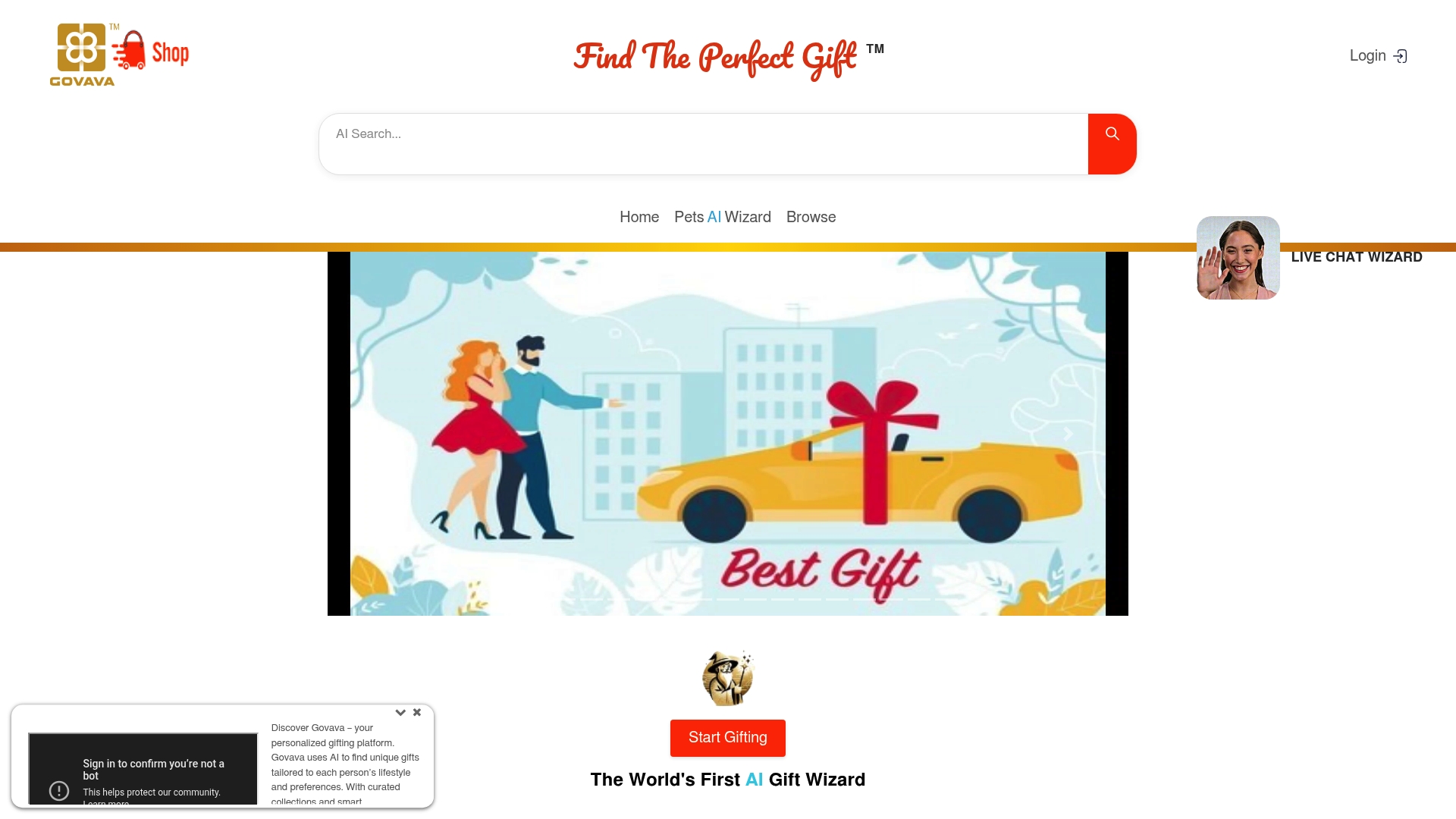
The platform includes persistent giftee memory so you never repeat a gift, occasion-aware suggestions that shift with the calendar, and a direct path from recommendation to purchase. Whether you are shopping for a milestone birthday, a last-minute anniversary, or a thoughtful "just because" moment, Govava makes the whole process feel less like a chore and more like a conversation. Start your AI gift search and find something they will actually love.
FAQ
What is an AI gift finder?
An AI gift finder is a recommendation tool that uses natural language understanding and machine learning to suggest personalized gifts based on the recipient's interests, relationship to the buyer, occasion, and budget. It replaces generic category browsing with a conversational, recipient-first approach.
How does an AI gift finder differ from a regular gift search?
A regular gift search returns broad results based on keywords or categories, while an AI gift finder profiles the recipient through conversation and matches suggestions to real, purchasable products in a live catalog. Kate Spade's AI Concierge demonstrated this difference with a 3.5× higher conversion rate compared to standard keyword search.
What information should I give an AI gift finder?
Provide the recipient's relationship to you, age range, top interests, personality traits, the occasion, and your budget. More concrete inputs like these directly improve the relevance of AI-generated gift recommendations.
Can AI gift finders complete the purchase for me?
Yes, agentic AI gift finders like Kohl's conversational agent integrate image uploads, in-chat browsing, and cart management so you can go from recommendation to checkout without leaving the chat interface.
Are AI gift suggestions truly personalized?
AI gift suggestions are personalized to the degree that your inputs are specific and the platform's catalog is deep. Tools grounded in real-time product data and enriched with recipient profiling, like Govava's AI Gift Wizard, produce meaningfully tailored results rather than recycled generic lists.