

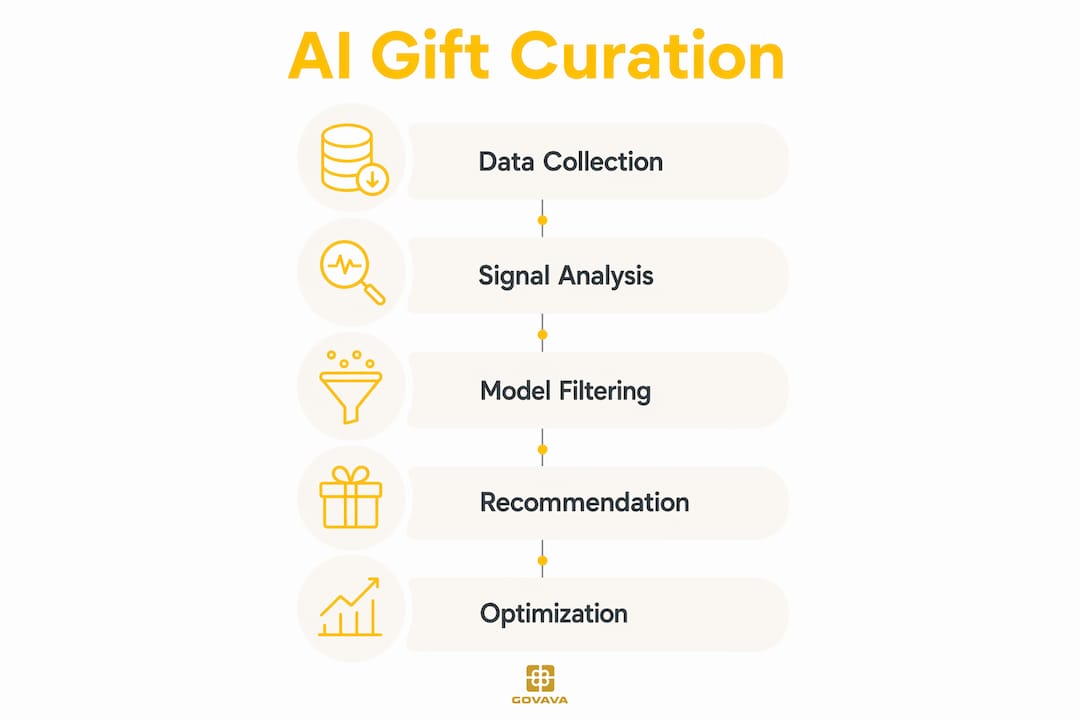
AI gift curation is defined as a recommendation process where machine learning models analyze shopper behavior, product metadata, and contextual signals to predict and rank the most relevant gifts for a specific recipient. This is not guesswork. It is algorithmic precision applied to one of the most emotionally loaded shopping experiences humans face. Whether you are hunting for a birthday gift for your best friend or a thoughtful anniversary surprise for your partner, understanding how AI recommends gifts can transform your entire approach to shopping. Platforms like Govava have built their entire identity around this process, combining behavioral intelligence with emotional context to make gift discovery feel less like a chore and more like a conversation with someone who actually knows your recipient.
How AI curates gift ideas: the data and signals behind every recommendation
The magic starts with data, and there is a lot more of it than you might expect. AI gift curation uses shopper signals and product metadata to rank items by predicted relevance, not by some subjective notion of what makes a "best gift." Every search term you type, every product page you linger on, every purchase you complete sends a signal that the system absorbs and weighs.
On the product side, the AI reads metadata with the focus of a seasoned librarian. Clear product descriptions and tags like "Mother's Day gift" or "eco-friendly" help AI place gifts in front of relevant shoppers at exactly the right moment. A candle labeled simply "candle" competes with thousands of other candles. A candle labeled "hand-poured soy candle, relaxation gift, wellness, Mother's Day" gets surfaced to the right person at the right time. That distinction is enormous for both shoppers and sellers.
Contextual signals add another layer of intelligence. Budget range, occasion type, delivery deadline, and even the relationship between giver and recipient all feed into the ranking process. Think of it as the AI building a mental picture of your situation before it ever shows you a single product. Behavioral and contextual signals lead to more meaningful recommendations than coarse demographic data alone, which means telling an AI "she loves hiking and her birthday is in three days" beats telling it "female, age 32" every single time.
- Search terms and click patterns reveal intent in real time, showing the AI what category and price range you are exploring.
- Purchase history builds a longer-term profile of your gifting style and the preferences of people you have shopped for before.
- Occasion and timing data help the system prioritize items that can actually arrive on time and fit the emotional weight of the event.
- Product tags and category metadata determine whether a gift even enters the candidate pool for your specific query.
Pro Tip: When using an AI gift platform, be as specific as possible in your search terms. "Outdoor adventure gift for a 35-year-old who loves trail running, budget $75" will generate far more relevant results than "gift for a guy who likes sports."
How AI models and business rules work together to generate gift recommendations
Picture a two-person team working in perfect sync. One person sprints through a warehouse of ten thousand products and pulls a shortlist of candidates in seconds. The other sits at a desk and carefully scores each candidate against a detailed rubric. That is essentially how modern AI recommendation systems operate. Retrieval and ranking model design is the key pattern for scalable, low-latency, and personalized recommendation systems, and it is the architecture powering most serious gifting platforms today.

The retrieval stage is built for speed. It scans the full product catalog and identifies hundreds of plausible candidates based on broad relevance signals. The ranking stage is built for accuracy. It applies a more detailed model to score each candidate against the specific user's profile, occasion context, and predicted preferences. This two-stage recommendation process enables personalized, efficient gift suggestions that incorporate complex user and product features without slowing the experience to a crawl.
Business rules then act as the final quality filter. These are not AI decisions. They are human-defined guardrails that the system enforces automatically.
- Stock status filters remove out-of-stock items before they ever reach you, saving the frustration of falling in love with something unavailable.
- Price ceiling rules cap results at your stated budget so you are never tempted by options you cannot afford.
- Shipping constraint checks verify that a product can actually reach its destination before the occasion, especially critical for last-minute shoppers.
- Brand safety rules exclude categories or products that conflict with the platform's editorial standards or the occasion's emotional tone.
AI gifting workflows combine recipient profiling, gift selection, bundling, timing, messaging, and optimization with these rule-based guardrails to produce a curated shortlist with rationale messaging. You do not just get a list of products. You get a list of products with reasons, which builds trust and makes the decision far easier. Human oversight remains especially important for VIP relationships and high-stakes occasions, where a purely automated output could feel cold or miss important nuance.
Pro Tip: If an AI gift platform shows you a "why we picked this" explanation alongside each suggestion, pay attention to it. That rationale is the system's way of showing its work, and it helps you quickly identify whether the recommendation actually fits your recipient.
How does conversational AI enhance personalized gift discovery?
Static search bars are fine for buying a phone charger. They are genuinely terrible for finding a gift that feels personal. Conversational AI changes this dynamic entirely by turning the discovery process into a dialogue. Instead of forcing you to translate your knowledge of a person into keywords, a conversational AI builds recipient profiles via chat, gathering relationship and occasion context iteratively for improved relevance.
Imagine typing: "I need a gift for my dad. He retired last month, loves cooking, and is not really into gadgets." A conversational system does not just search for "retirement gift." It processes the relationship, the life event, the hobby, and the constraint simultaneously. Conversational AI can simultaneously analyze nuanced intent across multiple product categories, which is why it consistently outperforms keyword search for complex gifting scenarios. The result is a set of suggestions that feel like they came from a thoughtful friend, not a search engine.
Compare this to structured quiz-based approaches. An AI gift finder quiz can collect structured data over time to tailor suggestions to budget, occasion, and personalization level. One example involves a 71-question quiz completed in about ten minutes that produces primary and backup gift ideas matched to preferences. That level of depth is impressive, but it requires patience. Conversational AI achieves similar depth in a fraction of the time by asking follow-up questions naturally, the way a knowledgeable salesperson would. You can learn more about this approach in Govava's guide to conversational shopping AI.
- Hard-to-shop-for recipients benefit most from conversational AI because the system can probe for niche interests and lifestyle details that a keyword search would never surface.
- Real-time delivery timing checks happen inside the chat flow, so you never get excited about a suggestion that cannot arrive in time.
- Iterative refinement lets you say "show me something more personal" or "I want something under $50" and the system adjusts without starting over.
What practical tips can you use to get the best AI-curated gift ideas?
Getting great results from an AI gift platform is a skill, and it is one you can develop quickly. The single most impactful thing you can do is provide rich, specific recipient information upfront. The AI cannot read your mind, but it can absolutely read your inputs. Think about your recipient's hobbies, daily routines, recent life events, and even things they have mentioned wanting. Feed that context into the platform and watch the quality of suggestions improve dramatically.
Occasion specificity matters just as much as recipient detail. "Birthday" and "milestone 40th birthday for someone who just moved to a new city" are technically the same occasion, but the second framing unlocks a completely different set of relevant suggestions. Budget precision also helps. Giving a range like "$60 to $90" is more useful than saying "around $75" because it gives the ranking model clear boundaries to work within.
- Refine your search terms by adding adjectives that describe personality or lifestyle, not just demographics.
- Use filters actively on gift marketplaces to narrow by occasion, material, or personalization options rather than relying solely on the AI's first pass.
- Look for curated lists on gifting platforms because these are often hand-reviewed collections that combine AI ranking with editorial judgment.
- Trust the AI for discovery, but apply your own judgment for the final decision. The system surfaces options you might never have found. You decide which one feels right.
Pro Tip: If the first round of AI suggestions feels off, do not abandon the platform. Refine your inputs rather than starting from scratch. Adding one or two specific details, like a favorite TV show or a recent travel destination, can shift the results entirely.
Understanding how AI learns your family's interests for better gifts is a great next step if you want to get more out of these platforms over time.
How is AI transforming gift curation for retailers and gifting platforms?
The commercial applications of AI gifting go far beyond helping individual shoppers. Retailers and gifting platforms are using these tools to operate at a scale that would be impossible with human curation alone. Commercial AI gifting integrates CRM data, segmentation, and predictive models for scalable, personalized gift selection, meaning a company can send thousands of genuinely thoughtful corporate gifts without a team of people manually selecting each one.
The automation extends across the entire gifting workflow. Timing triggers send gift recommendations ahead of key dates like birthdays and anniversaries. Bundling algorithms identify product combinations that feel more generous and cohesive than single items. Messaging tools generate personalized notes that match the occasion's tone. Fulfillment integrations check inventory and shipping windows in real time. Together, these capabilities turn what was once a labor-intensive process into something that runs almost on its own.
| Capability | What it does for gifting |
|---|---|
| CRM integration | Pulls recipient data to personalize suggestions at scale |
| Predictive timing | Triggers gift recommendations ahead of key dates automatically |
| Bundling algorithms | Groups complementary products into cohesive gift sets |
| Metadata optimization | Improves product discoverability through better tagging and descriptions |
| Human review checkpoints | Adds oversight for high-value or sensitive gifting occasions |
The metadata quality point deserves special attention. Retailers who invest in detailed, occasion-specific product descriptions see their items surface more frequently in AI-curated results. This creates a direct commercial incentive to write better product content, which ultimately benefits shoppers too. It is one of those rare situations where the interests of sellers, platforms, and buyers all point in the same direction.
Key takeaways
AI curates gift ideas by combining behavioral signals, product metadata, and rule-based filters through a two-stage retrieval and ranking process that delivers personalized, relevant suggestions faster and more accurately than traditional search.
| Point | Details |
|---|---|
| Data signals drive relevance | Search terms, purchase history, and occasion context produce far better results than demographic data alone. |
| Two-stage AI architecture | Fast retrieval narrows the catalog; detailed ranking scores candidates against your specific profile and needs. |
| Business rules add guardrails | Stock status, budget limits, and shipping checks filter out impractical options before you see them. |
| Conversational AI beats keyword search | Chat-based interfaces gather nuanced recipient context iteratively, improving suggestion quality significantly. |
| Rich inputs produce rich outputs | Providing specific personality, lifestyle, and occasion details is the single most effective way to improve AI gift recommendations. |
Why AI gifting still needs the human touch
I have spent a lot of time watching people interact with AI gift platforms, and here is the thing that most articles get wrong: the technology is not the bottleneck. The human is. Most people give AI gift tools the bare minimum of information and then wonder why the suggestions feel generic. "Gift for my mom" is not a brief. It is a shrug.
The platforms that genuinely impress me are the ones that have figured out how to make data collection feel like a conversation rather than a form. When you are chatting with an AI that asks "what does she do on a Sunday morning?" instead of "list her hobbies," you get answers that actually mean something. That is where the emotional intelligence of these systems starts to show up in the output.
That said, I do think there is a real risk of over-automation, particularly for high-stakes occasions. A fully automated corporate gifting workflow might produce technically correct results while completely missing the emotional register of the moment. The balance between automation and human review is not a nice-to-have. It is what separates a gift that lands from one that lands awkwardly. My honest advice: use AI for discovery and shortlisting, then apply your own judgment for the final call. The AI is your trusty sidekick in this story, not the hero.
— carl
Find your perfect gift with Govava's AI gift wizard
Govava was built for exactly the moments described throughout this article: the occasions where you want to give something genuinely thoughtful but do not know where to start. Govava's AI matches recipient profiles with curated products using personality, lifestyle, relationship context, and occasion details, so every suggestion feels considered rather than random.
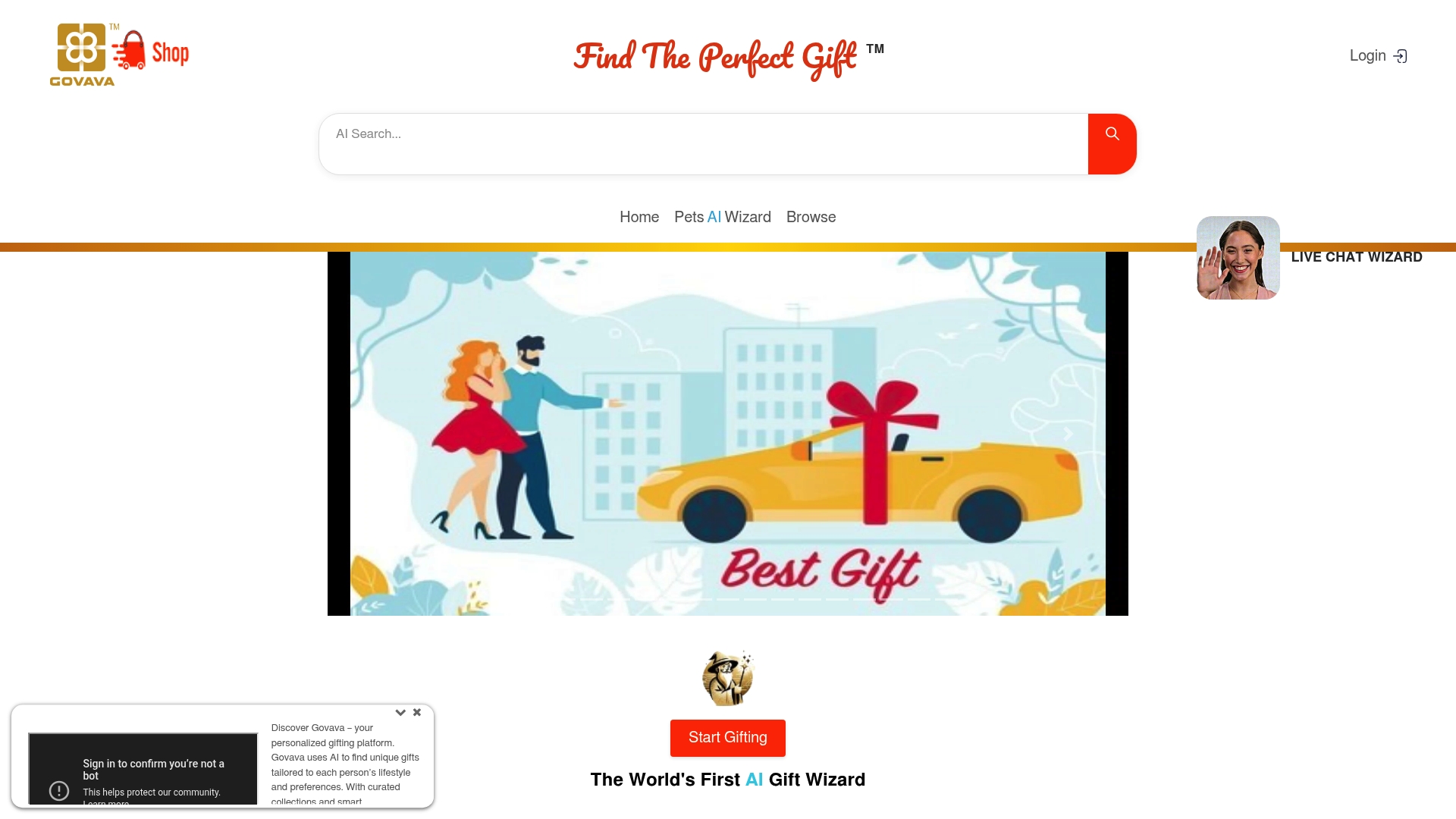
The platform's AI Gift Wizard walks you through a conversational discovery process that surfaces personalized gift ideas in real time, complete with rationale for each suggestion. Whether you are shopping for a milestone birthday, a last-minute anniversary, or a hard-to-please parent, Govava's personalized gift search gives you a starting point that actually makes sense. Try it and see how different gift shopping feels when the AI is working with real context.
FAQ
What is AI gift curation exactly?
AI gift curation is the process of using machine learning models to analyze shopper behavior, product metadata, and contextual signals to rank and recommend the most relevant gifts for a specific recipient and occasion.
How does AI know what gift to suggest for someone?
AI analyzes inputs like search terms, purchase history, occasion type, budget, and recipient details to predict which products are most likely to resonate. The more specific the input, the more accurate the suggestion.
Is conversational AI better than a gift quiz for finding presents?
Conversational AI gathers nuanced recipient context iteratively through natural dialogue, which typically produces more relevant results faster than a structured quiz. A 71-question quiz can match depth, but requires significantly more time and effort from the user.
Why do AI gift recommendations sometimes feel generic?
Generic recommendations usually result from sparse or vague input data. AI systems perform best when given specific personality traits, lifestyle details, and occasion context rather than broad demographic information alone.
How do retailers use AI for gift curation at scale?
Retailers integrate CRM data, predictive analytics, and automated workflows to deliver personalized gift recommendations across thousands of recipients simultaneously, using timing triggers and bundling algorithms to automate the entire gifting process.