

You describe your friend as "outdoorsy, obsessed with coffee, and impossible to shop for," and within seconds an AI returns a curated shortlist of gifts that actually make sense. No endless scrolling, no frustrated tab-switching. Understanding how AI gift assistants learn preferences reveals something genuinely surprising: these systems are not running a fancy quiz behind the scenes. They are reading between the lines of your words, tracking your behavior, and updating your profile in real time, more like a sharp-eared personal shopper than a search bar with filters.
Table of Contents
- Key Takeaways
- How AI gift assistants learn preferences from conversation
- The feedback loop that keeps refining your results
- Contextual constraints that shape what AI recommends
- Behind the scenes: how the technology actually works
- Getting the most out of your AI gift assistant
- My honest take on where AI gifting is headed
- Find the perfect gift with Govava's AI Gift Wizard
- FAQ
Key Takeaways
| Point | Details |
|---|---|
| Conversational inference beats filters | AI extracts personality, budget, and relationship cues from natural language, not checkbox menus. |
| Feedback loops sharpen accuracy | Every click, skip, and purchase updates your preference profile, making future suggestions more relevant. |
| Context shapes every recommendation | Occasion, budget, and delivery timing are active inputs that change what the AI suggests, not afterthoughts. |
| Multi-stage pipelines work in milliseconds | Candidate retrieval, ranking, and re-ranking happen fast enough that personalization feels instant. |
| You can train your AI assistant faster | Specific, descriptive inputs and honest feedback teach the system to understand you more quickly. |
How AI gift assistants learn preferences from conversation
Most people assume AI gift tools work like an advanced search engine: you type a category, set a price range, and get a filtered list. The reality is considerably more interesting. Modern systems, including conversational gift assistants, translate a single free-text sentence into a rich set of structured features spanning relationship type, personality tone, lifestyle interests, and implicit budget expectations. That structured profile then gets matched against a product catalog in real time.
Picture this. You tell an AI: "I need something for my mom, she loves gardening and is really into wellness lately, budget around $60." The system does not just hear "gardening" and "wellness." It infers a relationship context (parent, likely 50+), a lifestyle cluster (outdoors, health-conscious), a price ceiling, and a tone preference (thoughtful over flashy). What you share in that one sentence does the work of a ten-question quiz, but feels like texting a friend.

The follow-up questions a well-designed AI asks are equally telling. Instead of "What category?" it might ask, "Does she prefer experiences like a spa day or physical items she can use daily?" That distinction is not a category filter. It is a personality probe, helping the system distinguish between a practical introvert and an experience-seeking extrovert. Kate Spade's AI gift concierge uses exactly this kind of natural dialogue, and 53% of shoppers report feeling stressed during gift purchases, making that reassuring conversational style genuinely valuable.
Here is what AI is actually extracting from your words:
- Relationship signal: The emotional weight and formality level appropriate for the recipient (colleague vs. best friend vs. parent)
- Interest clusters: Hobbies, passions, and lifestyle patterns that map to specific product categories
- Personality tone: Whether the recipient skews playful, sophisticated, practical, or sentimental
- Implicit budget: Price sensitivity inferred from word choice, even before you state a number
- Style preferences: Aesthetic cues picked up from adjectives like "minimalist," "cozy," or "bold"
Pro Tip: Describe the recipient as you would to a friend, not as a search query. Phrases like "she is really into functional kitchen gadgets and hates clutter" give the AI far more to work with than "kitchen gifts under $50."
The feedback loop that keeps refining your results
Here is where AI gift recommendation technology gets genuinely clever. The first recommendation is educated, but it is a hypothesis. What you do next is the real data. Behavioral signals like clicks and skips feed directly back into the system, updating your preference profile continuously. This is the closed feedback loop that separates adaptive personalization from static segmentation.
Think of it as a conversation that never fully ends. Each interaction teaches the system something new.
- You browse a candle set but skip a scented diffuser for the same recipient. The AI notes a preference for physical consumables over device-based wellness products.
- You purchase a leather journal and rate it highly. The system registers "tactile, artisan quality" as a strong positive signal.
- Next time you shop for a similar recipient profile, those signals push handcrafted and sensory-rich products higher in the ranking.
- Over multiple sessions, the system builds a nuanced taste map for each gift recipient type in your life, not just a generic user profile.
"The essence of helpful AI personalization lies in continuous feedback loops updating user profiles based on immediate behavioral responses, not static segmentation." — Personalization Engine: Relevance at Scale
This is what platforms like Alexa for Shopping have built at scale. The system remembers preferences and conversations across sessions, deepening its understanding rather than starting from scratch each time. The practical benefit for you is that a gifting AI gets meaningfully better the more you use it. Early recommendations are good. Later ones can feel almost prescient.
Contextual constraints that shape what AI recommends
Knowing someone loves sustainable home goods is only half the equation. A gift suggestion lives or dies by whether it fits the situation. AI systems that understand personalization also learn to elicit and confirm contextual constraints, and those constraints actively reshape the recommendation pool.
Occasion context is the first filter. A birthday gift for a close friend carries very different expectations than a thank-you gift for a colleague or a holiday gift for a distant relative. A well-designed assistant will confirm the occasion early and weight its suggestions accordingly, because the same person might receive a quirky, personal gift for their birthday but something more universally polished as a thank-you.
Budget is where many AI systems either shine or frustrate. A graceful AI does not just cut off results at your stated ceiling. It also reads the tone of your budget, understanding that $50 feels generous for a coworker but modest for a spouse's anniversary. The goal is relevance within range, not just compliance with a number.
Delivery timing might be the most underestimated constraint of all. 61% of customers say delivery information can make or break a purchase decision, and AI systems that ignore this lose conversions even when the product recommendation is perfect. An AI assistant that surfaces a beautiful gift with a 10-day shipping window when you need something in three days is not actually being helpful. Learn more about how delivery and pricing constraints factor into AI gifting recommendations.
| Constraint type | What AI learns from it | Impact if ignored |
|---|---|---|
| Occasion | Formality level, emotional weight, gift category norms | Tone mismatch, socially awkward suggestions |
| Budget | Price ceiling, perceived generosity for relationship type | Irrelevant results, friction and frustration |
| Delivery timing | Feasibility window, shipping options, digital vs. physical | Lost purchase even with a perfect product match |
| Recipient age and life stage | Category relevance, practical vs. aspirational lean | Suggestions that miss the mark entirely |
Pro Tip: Tell the AI your deadline upfront, not as an afterthought. Saying "I need this by Friday" immediately after describing the recipient lets the system filter out anything that cannot realistically arrive in time, saving you from falling in love with a gift you cannot actually give.
Behind the scenes: how the technology actually works
You type a sentence. A recommendation appears in seconds. What happens in between is a multi-stage engineering process that most people never think about, but understanding it explains why some AI gift tools feel so much sharper than others.
Modern recommender pipelines work in three stages: candidate retrieval, ranking, and re-ranking. Candidate retrieval narrows a catalog of thousands of products down to a few hundred plausible matches using broad preference signals. Ranking then scores those candidates against the full preference profile, including relationship type, personality tone, budget, and occasion. Re-ranking is where the magic happens, incorporating session-level context like what you just viewed, skipped, or clicked.
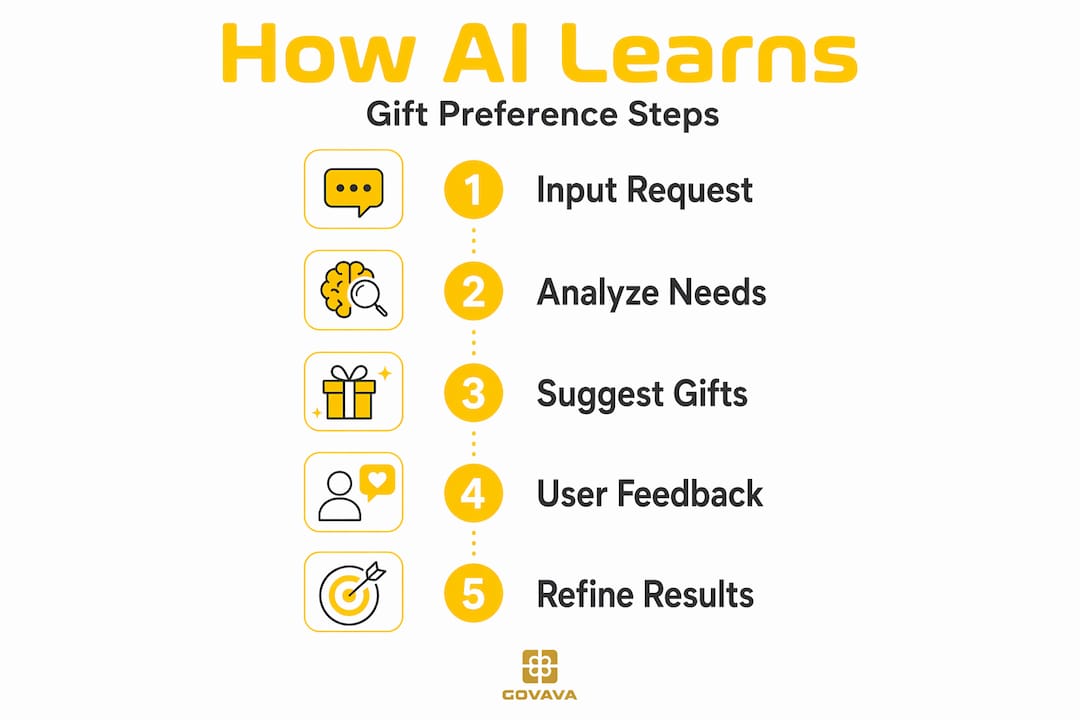
The entire process runs in milliseconds, which is why it feels instant. But the sophistication lies in what feeds it. Free-text input from your conversation gets converted into structured metadata before it ever reaches the ranking stage. Words like "minimalist," "practical," or "loves the outdoors" are mapped to feature vectors that the model understands as product attributes.
| Feature | Basic filter approach | AI personalization approach |
|---|---|---|
| Category selection | User picks from a dropdown list | AI infers category from personality description |
| Budget handling | Hard price range cutoff | AI reads tone of budget relative to relationship |
| Occasion context | Optional tag, often ignored | Active input that reshapes the entire recommendation pool |
| Learning over time | Static, resets each session | Dynamic, updates with every behavioral signal |
There is also the "filter bubble" problem worth knowing about. An AI that only shows you what your profile predicts you will like can quickly feel repetitive and stale. Well-designed systems apply diversity quotas to ensure a portion of recommendations fall slightly outside your established taste pattern. For AI-powered personalized shopping to stay genuinely useful, it needs to surface both the obvious perfect fit and the unexpected discovery that makes you think, "I never would have found that on my own."
Pro Tip: When you see a recommendation that surprises you, engage with it even if you do not buy it. Clicking it and spending time on the page tells the system your taste is broader than it assumed, which produces more interesting results next time.
Getting the most out of your AI gift assistant
Working with an AI gifting tool well is a small skill worth developing. The system is only as good as what you feed it, and a few habits make a real difference.
- Be descriptively generous upfront. The more texture you give in your first message, the richer the initial recommendation set. "She is a creative professional who travels a lot and values quality over quantity" beats "gifts for a 32-year-old woman."
- State the occasion and timeline together. This single habit eliminates the most common source of useless suggestions: timing-incompatible or tone-wrong gifts.
- Engage honestly with the results. If a suggestion misses, say why. "Too formal" or "she would never use this" teaches the system faster than simply skipping.
- Give the AI multiple interactions before judging it. The first session is a starting point. By the third or fourth, the system has built enough behavioral data to produce genuinely personal suggestions, not just statistically common ones.
- Avoid contradictory signals. If you click enthusiastically on premium artisan goods but consistently filter for the lowest price tier, you will confuse the ranking model. Decide which signal you want the system to follow and be consistent.
Following a step-by-step approach to AI gift finding from your very first session pays dividends over time, because every interaction compounds into a sharper, more personalized experience.
My honest take on where AI gifting is headed
I've spent a lot of time watching AI gift tools evolve, and the shift from rigid filter-based systems to genuinely conversational ones is the most meaningful change I've seen. The old approach felt like filling out a form. The new approach feels like talking to someone who is actually paying attention.
What I find most exciting is not the technology itself but what it means for the human on the other end. The burden of remembering that your brother-in-law switched from coffee to matcha, or that your best friend is going through a minimalist phase, is quietly being lifted. AI is taking notes so you do not have to.
The honest challenge I see is the filter bubble risk. Systems that over-optimize for your existing preferences stop being discovery tools and become mirrors. The best platforms I have seen combat this deliberately, and I think the ones that get diversity right will win long-term loyalty.
The future I am genuinely excited about is AI that understands emotional context as well as it understands product attributes. Knowing someone is going through a tough year and weighting suggestions toward comfort and warmth rather than novelty and excitement would be a meaningful leap. We are not fully there yet, but the trajectory is clear and honestly kind of wonderful.
— carl
Find the perfect gift with Govava's AI Gift Wizard
Govava brings everything covered in this article to life in one place. The AI Gift Wizard learns your preferences through real conversation, asks the right follow-up questions, and adapts to every occasion, budget, and delivery window you throw at it. There is no form to fill out and no endless category browsing. You describe the person, share the occasion, and let the AI do the matching.
Whether you are shopping for a last-minute birthday surprise or a carefully considered anniversary gift, Govava's personalized gift recommendations adjust in real time as the system learns what resonates with you. You can also explore the full gift catalog through Govava's AI search, which surfaces curated ideas based on personality, lifestyle, and relationship context rather than keyword guessing. Give it one honest conversation, and you will see exactly why smarter gifting feels this good.
FAQ
How does AI detect gift preferences without a questionnaire?
AI gift assistants infer preferences from natural language descriptions, extracting relationship type, personality tone, interests, and budget signals from a single conversational input rather than a structured form.
What makes AI gift recommendations more accurate over time?
Behavioral feedback like clicks and skips continuously updates your preference profile, so each interaction teaches the system more about your specific taste and the tastes of people you shop for.
Why does delivery timing matter to AI gift assistants?
Delivery information shapes purchase decisions for the majority of shoppers, so AI systems that factor in timing constraints alongside product relevance produce recommendations you can actually act on.
Can an AI gift assistant learn preferences for different people in my life?
Yes. Most adaptive gift selection systems build separate preference profiles for each recipient type you describe, meaning the AI learns distinct taste maps for your mom, your best friend, and your coworker over time.
What should I do if AI gift suggestions do not feel personal enough?
Add more descriptive context about the recipient's personality and lifestyle, engage with results by clicking and skipping deliberately, and give the system several sessions to accumulate enough behavioral data to sharpen its recommendations meaningfully.