

You already know AI is changing things. But most people think it's just a chatbot answering customer service questions behind the scenes. The role of AI in modern shopping goes much deeper than that, and it's already reshaping how you discover products, compare prices, and even complete purchases, sometimes without lifting a finger. In fact, 19% of all car buyers used AI during their shopping journey, with 59% reporting high satisfaction. That's not a niche trend. That's a signal.
Table of Contents
- Key takeaways
- How AI shapes your personalized shopping experience
- How AI optimizes retail operations behind the scenes
- The rise of AI shopping assistants and autonomous agents
- Challenges and implications for shoppers in 2026
- My take on navigating AI in your shopping life
- Let Govava's AI do the hard work for you
- FAQ
Key takeaways
| Point | Details |
|---|---|
| AI personalizes at scale | Recommendation engines use real-time behavioral data to match products to individual preferences with striking accuracy. |
| Retailer-owned AI outperforms | AI built by retailers converts five times better than third-party agents due to direct data access and consumer trust. |
| Autonomous shopping is here | AI agents like Google's Universal Cart can now search, compare, and purchase on your behalf without manual input. |
| Privacy trade-offs are real | AI aggregates data across platforms, creating convenience but raising genuine questions about how your information is used. |
| Clean data drives AI quality | The more structured a retailer's product data, the better AI can surface relevant results for you as a shopper. |
How AI shapes your personalized shopping experience
Picture this: you open a shopping app and the first ten products you see are exactly what you were mentally searching for. No scrolling, no filtering, no frustration. That's AI personalized shopping working at full speed, and it's powered by recommendation engines that track your clicks, dwell time, purchase history, and even what you put in your cart and then abandoned.
These engines do not just show you "things you might like." They learn the difference between what you browse out of curiosity and what you actually buy. Over time, they build a behavioral model of you that is sharp as a tack, updating in real time as your preferences shift across seasons, life events, and moods.
The experience goes well beyond product suggestions. Here is where AI really starts to shine:
- Virtual try-on tools powered by generative AI let you see how a jacket or a pair of sneakers looks on your body before buying. Virtual try-on technology boosts conversion by roughly 10% for fashion brands and significantly reduces return rates.
- Dynamic content personalization changes the homepage, banners, and even product descriptions based on who you are, not just what category you clicked.
- Conversational AI shopping assistants let you describe what you need in plain language ("something cozy for a rainy Sunday") and get curated results back instantly.
The impact of AI in retail here is not abstract. It translates directly into higher satisfaction, fewer returns, and purchases that actually feel right. And for shoppers who have ever experienced the opposite, that matters enormously.
Pro Tip: If a retailer's app offers an AI-powered quiz or style profile, fill it out completely. The more context you give the system upfront, the faster it stops showing you things that miss the mark.
How AI optimizes retail operations behind the scenes
AI is not only your shopping companion. It is also the engine running the store you shop from, and understanding that makes you a smarter consumer. Retailers using advanced AI tools report up to 4% revenue growth and a 20 to 30% reduction in inventory costs, and those savings often translate into better pricing and product availability for you.
Here is how the back-end transformation actually works:
- Inventory prediction. AI analyzes sales velocity, seasonality, and even social media trends to predict what needs to be stocked before demand spikes. Fewer stockouts mean you find what you want when you want it.
- Dynamic pricing. Prices on many retail platforms adjust algorithmically based on demand, competitor pricing, and your browsing behavior. That flash sale you caught? AI probably generated it.
- Automated customer service. AI handles order tracking, returns, and basic troubleshooting around the clock, freeing human agents for complex situations.
- Order processing and fulfillment. Machine learning optimizes warehouse routing, reducing shipping times and errors.
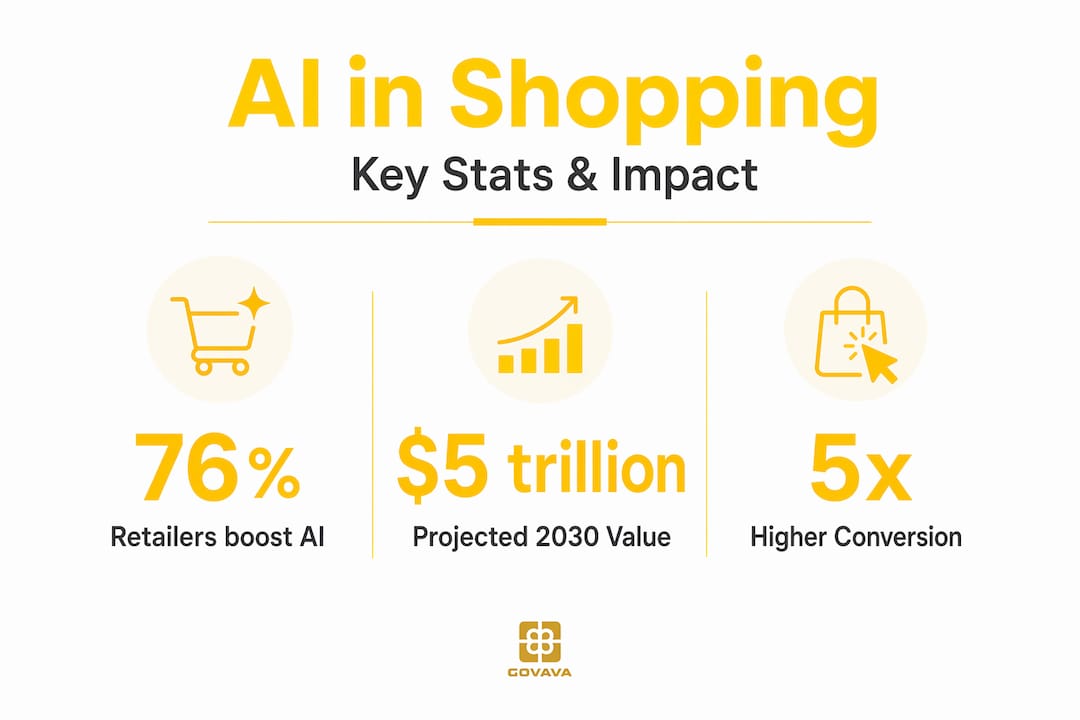
The economic picture is striking. Agentic AI could generate between $3 and $5 trillion in global retail value by 2030, largely by automating thousands of micro-decisions per hour that humans simply cannot process at that speed.
Here is a quick look at where these operational gains show up most clearly:
| AI Application | Retailer Benefit | Shopper Benefit |
|---|---|---|
| Demand forecasting | Fewer overstock write-offs | Items in stock when you need them |
| Dynamic pricing | Higher margin efficiency | Competitive, real-time pricing |
| Automated fulfillment | Faster warehouse processing | Quicker delivery windows |
| AI customer service | Lower support costs | 24/7 resolution without wait times |
The retail industry's embrace of these tools is accelerating fast. 76% of retailers plan to increase their AI agent investments within a year. You are shopping inside a system that is getting smarter every single quarter.
The rise of AI shopping assistants and autonomous agents
Here is where how AI changes the shopping experience gets genuinely fascinating, and a little futuristic. AI shopping assistants used to mean a search bar with better autocomplete. Now they mean something far more capable.

There are two distinct categories worth knowing. The first is the AI shopping assistant, a conversational tool that helps you find, compare, and evaluate products based on natural language input. Amazon's Rufus, for example, can answer questions like "What's a good gift for a fitness-obsessed dad?" and pull relevant results from across the entire catalog. It is your trusty sidekick in the browsing phase.
The second category is the autonomous AI agent, and this is where the real shift happens. These systems do not wait for you to ask questions. They act on your behalf. Google's Universal Cart and Gemini Spark represent this leap forward, enabling AI to research products, compare across retailers, and complete purchases autonomously. You set the parameters; the AI executes the mission.
The practical difference between these two types of tools matters a lot:
- Autonomous agents excel at routine, low-consideration purchases like household staples, where speed matters more than deliberation.
- Shoppers tend to prefer retailer-controlled AI for bigger, more complex decisions like electronics, furniture, or gifts, where trust and accuracy are non-negotiable.
And trust is the crux of this story. Retailer-owned AI converts at a rate five times higher than third-party AI assistants, because it has direct access to real-time inventory, pricing, and product data. A third-party agent scraping the web for prices might show you a deal that expired yesterday. A retailer's own AI knows exactly what is on the shelf right now.
Consumers also trust retailer-operated AI agents three times more than those from outside platforms. When an AI is making purchase decisions for you, that trust gap is not a small detail. It is everything.
Challenges and implications for shoppers in 2026
No technology this powerful arrives without trade-offs. The future of AI in commerce is exciting, but it is also worth knowing what you are signing up for as a consumer.
The most pressing concern is data privacy. AI shopping systems aggregate your behavioral data across platforms, devices, and sessions to build that eerily accurate profile of you. The same precision that surfaces the perfect product also means a detailed picture of your habits, preferences, and finances is being assembled constantly. Cross-platform AI shopping has already driven a 58% drop in traditional organic click-through rates, meaning you are increasingly interacting with AI-curated results rather than browsing freely. That shift is subtle but significant.
Brand loyalty is also evolving in ways most shoppers have not noticed yet. When an AI agent selects a product for you, it optimizes for criteria like price, reviews, and availability. Your emotional connection to a particular brand may not factor in at all. Over time, this could flatten brand differentiation and make algorithmic rankings the new store shelf.
There is also the question of retailer readiness. AI agents require clean structured product data, API-based checkouts, and tokenized payment systems to function properly. Retailers who have not invested in that infrastructure will simply be invisible to autonomous AI agents, which means your AI might systematically skip certain stores or products not because they are inferior but because the data is messy.
"Brands ignoring deep product metadata and inventory accuracy risk losing visibility in AI-driven platforms entirely." — Vogue Business, 2026
Pro Tip: Review the privacy settings on any AI shopping tool you use regularly. Most platforms allow you to limit data sharing or reset your behavioral profile, which gives you more control over what the AI assumes about you.
As a shopper, your best move is to stay informed about which AI systems are acting in your interest versus a retailer's. Physical retail is evolving into a hub for tactile validation and immediate fulfillment, a complement to AI-driven discovery rather than a competitor to it. The savvy approach is using both well.
My take on navigating AI in your shopping life
I've watched the AI shopping space evolve rapidly, and the single thing I've seen most shoppers miss is the distinction between an AI that works for the retailer and one that works for you. They are not always the same thing.
In my experience, the retailer-owned AI tools are genuinely more useful for complex purchases. They have better data, more accountability, and a real incentive to get the recommendation right so you come back. Third-party aggregators are convenient, but I've found they often lag on pricing accuracy and can subtly push sponsored results without making that obvious.
What I've also noticed is that most people underestimate how deeply AI-driven personalization shapes not just what they see but what they want. When the algorithm surfaces a product repeatedly across contexts, it creates a kind of artificial familiarity that feels like preference. That is worth being aware of, not to distrust AI, but to stay conscious of the difference between a genuinely good fit and a well-placed suggestion.
My honest advice: lean into AI shopping assistants for efficiency and discovery. But keep your own judgment involved in the final call, especially for anything emotionally significant, like a gift for someone you care about. That is where human context still outperforms algorithmic precision every time.
— carl
Let Govava's AI do the hard work for you
If anything in this article resonated with you, especially the part about AI finally getting personalization right, then Govava was built for exactly that moment. Govava is an AI-powered gifting platform that does not just search a catalog. It understands who you are shopping for: their personality, lifestyle, interests, and the occasion, and matches that context to gifts people actually love.

Whether you are stumped for a birthday, an anniversary, or a "just because" moment, Govava's AI cuts through the noise in seconds. You can explore AI-curated gift ideas tailored to any personality or occasion, or browse thoughtfully recommended products that feel personal rather than generic. The same intelligence reshaping how you shop everywhere is here, focused entirely on making gift-giving feel effortless and genuinely meaningful. Give it a try and see what AI that understands emotional context actually feels like in practice.
FAQ
What is the role of AI in modern shopping?
AI plays an active role across discovery, personalization, pricing, and even autonomous purchasing. It shapes what products you see, how prices are set, and increasingly, whether a purchase happens at all without manual input from the shopper.
Are AI shopping assistants trustworthy?
Retailer-owned AI shopping assistants are generally more trustworthy than third-party agents, as consumers trust them three times more due to direct access to accurate, real-time inventory and pricing data.
How does AI personalized shopping actually work?
AI personalized shopping uses recommendation engines that analyze your browsing behavior, purchase history, and real-time interactions to surface products aligned with your individual preferences, updating continuously as your behavior changes.
Will AI eventually shop for me automatically?
Yes, in many categories it already does. Autonomous AI agents like Google's Universal Cart can research, compare, and complete purchases on your behalf, though most shoppers still prefer human control for high-consideration or emotionally meaningful purchases.
How can I make AI shopping tools work better for me?
Fill out preference profiles completely, review and reset your data settings periodically, and choose retailer-owned AI tools for complex or significant purchases where accuracy and trust matter most.