

Most people assume AI just spits out a generic list of gift ideas when you type in a name and click search. The reality is far more interesting. How AI interprets gifting occasions is the core mechanic that separates a truly useful recommendation from one that feels like it came off a clearance shelf. Occasion context shapes everything: the product category, the price range, the emotional tone, and even the urgency of delivery. Once you understand how that interpretation works, you can use AI gifting tools in a way that actually produces gifts people love.
Table of Contents
- Key takeaways
- How AI interprets gifting occasions
- Practical factors AI considers per occasion
- The human-AI relationship in gift personalization
- AI gifting versus traditional gift selection
- How to get the most from AI gifting tools
- My honest take on AI and occasion-based gifting
- Find perfect gifts with Govava's AI wizard
- FAQ
Key takeaways
| Point | Details |
|---|---|
| Occasion drives AI recommendations | Changing the occasion input shifts the entire product category, price, and tone of AI gift suggestions. |
| Clarifying questions sharpen results | AI asks about recipient, relationship, and budget early to transform vague intent into precise recommendations. |
| Delivery timing matters emotionally | For high-stakes occasions like anniversaries, AI factors in shipping logistics alongside gift selection. |
| Human effort still carries relational weight | AI drafts and suggests, but your personal message and thoughtful customization preserve emotional meaning. |
| Iteration improves AI accuracy | Providing feedback to AI suggestions refines results over time, making each recommendation more occasion-appropriate. |
How AI interprets gifting occasions
Picture this: you tell an AI gift tool "I need a gift." Nothing happens. Now you say "I need a gift for my mom's 60th birthday, budget around $80." Suddenly, the AI is a different creature entirely. That single piece of occasion context triggers a cascading set of filters that completely transform the suggestions you see.
Occasion context changes the entire gift idea set, adjusting tone, price range, and product category simultaneously. A birthday for a parent calls for warmth and sentimentality. A graduation gift leans celebratory and aspirational. An anniversary skews romantic and experiential. The AI is not just swapping out keywords. It is reconfiguring the logic of what counts as appropriate.
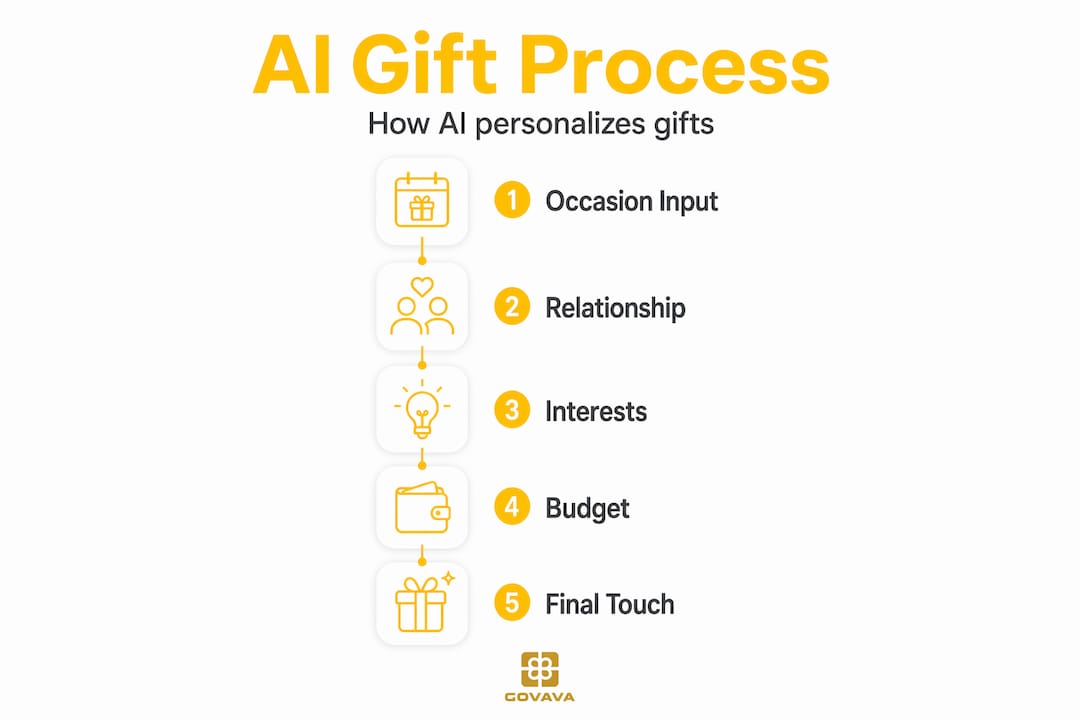
Here is how occasion-aware AI actually works, broken down into its key moving parts:
- Occasion type as a category trigger. When you input "anniversary," AI immediately narrows to categories like jewelry, experience packages, and personalized keepsakes, and excludes practical household items it might suggest for a housewarming.
- Recipient relationship as a tone filter. Shopping for a coworker versus a spouse shifts formality, price ceiling, and emotional depth. AI uses the relationship context to avoid misfires like gifting something too intimate for a professional connection.
- Budget as a hard constraint. The AI does not just acknowledge your budget. It uses it as a firm filter, ensuring suggestions cluster in the right range rather than offering you a $400 experience when you said $50.
- Delivery timing as urgency logic. A last-minute Valentine's Day gift triggers different product types than one purchased three weeks in advance, because the AI factors in shipping windows and local availability.
When occasion information is missing, good AI gift tools do not guess. AI asks proactively to clarify occasion for relevance, which is why the conversational gifting experience feels so much more accurate than a keyword search. The back-and-forth is not small talk. It is data collection with a warm smile.
Pro Tip: Give the AI as much occasion context as possible upfront, including the relationship dynamic, the recipient's general vibe, and any themes you want to avoid. More context equals sharper results, every time.
Practical factors AI considers per occasion
Understanding the mechanics is one thing. Seeing how AI handles the real-world constraints of gifting is where things get genuinely impressive. The AI gift recommendation engine requires occasion and budget as structured inputs, generating five tailored recommendations that account for interests, regional availability, and price simultaneously.
Here is the hierarchy of practical factors AI works through for any given occasion:
- Budget ceiling. This is the non-negotiable anchor. AI uses your stated budget to eliminate entire product categories and surface only what falls within a realistic range. Spend $60 on a birthday? The algorithm rules out anything that starts at $120 and filters in meaningful options in the right zone.
- Geographic availability. A personalized AI chatbot for gifting and flowers accounts for regional product availability, which matters when you need something delivered in a specific city or country. Recommending a boutique experience that does not exist in the recipient's area is a failure mode AI is trained to avoid.
- Delivery urgency tied to the occasion. For emotionally significant occasions, customers expect timely delivery alongside thoughtful product quality. AI that understands occasion context does not just pick a nice gift. It surfaces options that can actually arrive on time.
- Social appropriateness by occasion type. Occasion context acts like a social etiquette filter. A baby shower gift should be nurturing and practical. A retirement gift should feel celebratory, not mournful. The AI uses occasion as a latent constraint that enforces social norms without you having to spell them out.
- Price expectations by occasion gravity. AI recognizes that certain occasions carry implicit price expectations. A wedding gift from a close friend operates on different norms than a gift for a casual colleague's birthday. The occasion input helps AI calibrate what "generous" actually means in context.
This layered, occasion-aware reasoning is what separates genuine personalized gifts using AI from a simple product search. The AI is essentially running a quiet checklist in the background, and every answer you give it sharpens the output.
The human-AI relationship in gift personalization
Here is the part most people skip over, and they really should not. AI and emotion dance together in gifting, but they are not dancing at the same skill level. AI is light on its feet, fast, and full of suggestions. But it has never felt the specific joy of giving your partner exactly the right thing or the quiet disappointment of getting something that felt phoned in.
AI agents behave like feedback-driven explorers, capable of complex, humanlike behavior while lacking any true understanding of what a relationship means. This is not a flaw you need to fear. It is a feature you need to understand. The AI is your trusty sidekick, not the hero of the story.
"Small acts of cognitive effort in gift communication matter deeply for relationship care over time." The research is clear: outsourcing your birthday card message entirely to AI risks producing something perfect on the surface but hollow underneath.
This is the gifting pickle that nobody talks about. You can get an excellent product recommendation from an AI tool. What you cannot fully outsource is the feeling of being known. When your partner reads a gift message, they are not just reading words. They are reading evidence that you thought about them. AI can draft that message beautifully, but the most meaningful version still needs your fingerprints on it.
The sweet spot is using AI to discover gifts you might never have found on your own, then adding your personal layer. Customize the message. Add a handwritten note. Choose the wrapping that matches their aesthetic. Learn how to make gifting more personal by treating AI as a brilliant starting point, not a finishing line.

Pro Tip: Use AI to generate the gift idea and a draft message, then rewrite the message in your own voice before sending. You get the efficiency without sacrificing the personal touch that actually matters to the recipient.
AI gifting versus traditional gift selection
It helps to see this contrast directly. Both approaches have real strengths, and knowing the difference makes you a smarter user of both.
| Factor | Traditional gifting | AI-assisted gifting |
|---|---|---|
| Speed of discovery | Slow, relies on memory and browsing | Near instant, driven by occasion and preference inputs |
| Variety of options | Limited to what you already know | Broad, drawing from large product catalogs |
| Occasion sensitivity | Strong if you know the person well | Strong when given clear occasion context |
| Emotional insight | Genuine, rooted in relationship history | Simulated, based on pattern matching |
| Delivery logistics | Manual research required | Often integrated into recommendation flow |
| Iteration and refinement | Fixed by your own knowledge | Improves with each feedback loop |
The most honest thing you can say about machine learning and gifting is that AI wins on speed, scale, and variety, while human intuition still wins on depth and nuance. AI recommendations improve through iteration and user feedback rather than as one-shot picks. So the more you engage with it, the better it gets. That is not magic. That is a feedback loop doing exactly what it was built to do.
Where AI genuinely struggles is in reading the unspoken history between two people. Your grandmother's love of a specific perfume brand, the running joke between you and your best friend, the sentimental connection to a place you both visited years ago. These things live in your memory, not in a dataset. AI can surface a great gift. Only you can make it a perfect one.
How to get the most from AI gifting tools
Using AI for gifting well is less about trusting the technology and more about learning to speak its language. When you feed it good context, it gives you good results. When you leave it guessing, it guesses generically.
Here are the habits that actually make a difference:
- Lead with occasion and relationship. Before anything else, tell the AI what the occasion is and your relationship to the recipient. This is the single most effective input you can give, because it shapes all downstream recommendations.
- State your budget clearly and early. Do not say "something reasonable." Give a number. AI performs best when it has a firm constraint to work within rather than a fuzzy approximation.
- Include personality and interest signals. Mention hobbies, lifestyle preferences, and things the recipient already loves. An AI that knows someone is a home cook will not suggest a fitness tracker as a birthday gift.
- Use the feedback loop deliberately. If the first round of suggestions misses the mark, say why. "Too practical" or "I wanted something more experiential" gives the AI the correction signal it needs to recalibrate. You can explore AI gift discovery step by step to get comfortable with this process.
- Plan delivery timing into your search. Tell the AI when you need the gift to arrive. This filters out options with long lead times and keeps you in the zone of what is actually achievable before the occasion.
- Review and customize, do not just accept. Treat AI suggestions as a shortlist, not a final answer. Read the options, pick the one that resonates most, and then add your personal stamp before completing the purchase.
My honest take on AI and occasion-based gifting
I've spent a lot of time watching how people interact with AI gift tools, and the pattern that stands out most is this: the people who get the best results are the ones who treat occasion context as sacred input. They do not skim past it. They think about it carefully and give the AI something real to work with.
What I've also noticed is that occasion interpretation is the hardest problem for AI to get right without your help. It is not about product databases or pricing algorithms. It is about understanding that a 30th birthday gift for your best friend carries a completely different emotional weight than a 30th birthday gift for an acquaintance. That distinction lives in you, not in the model.
My take on the human-AI balance in gifting is that the best outcomes happen when you treat AI like a brilliant personal shopper who just started working with you. They are sharp as a tack on logistics, options, and availability. But they need you to brief them properly. The more context you give about the occasion, the recipient, and the emotional register you are aiming for, the better your AI gifting assistant performs.
The future I am watching for is AI that gets better at asking the right questions, not just collecting inputs. The tools that prompt you to think more deeply about your recipient, rather than just processing your quick answers, will produce genuinely thoughtful results. That is the version of AI gifting worth being excited about.
— carl
Find perfect gifts with Govava's AI wizard
If you have ever stared at a search bar wondering where to even start for an upcoming occasion, Govava was built for exactly that moment. Govava's AI Gift Wizard interprets your occasion, relationship, and budget details to surface personalized recommendations that actually fit the person and the moment.
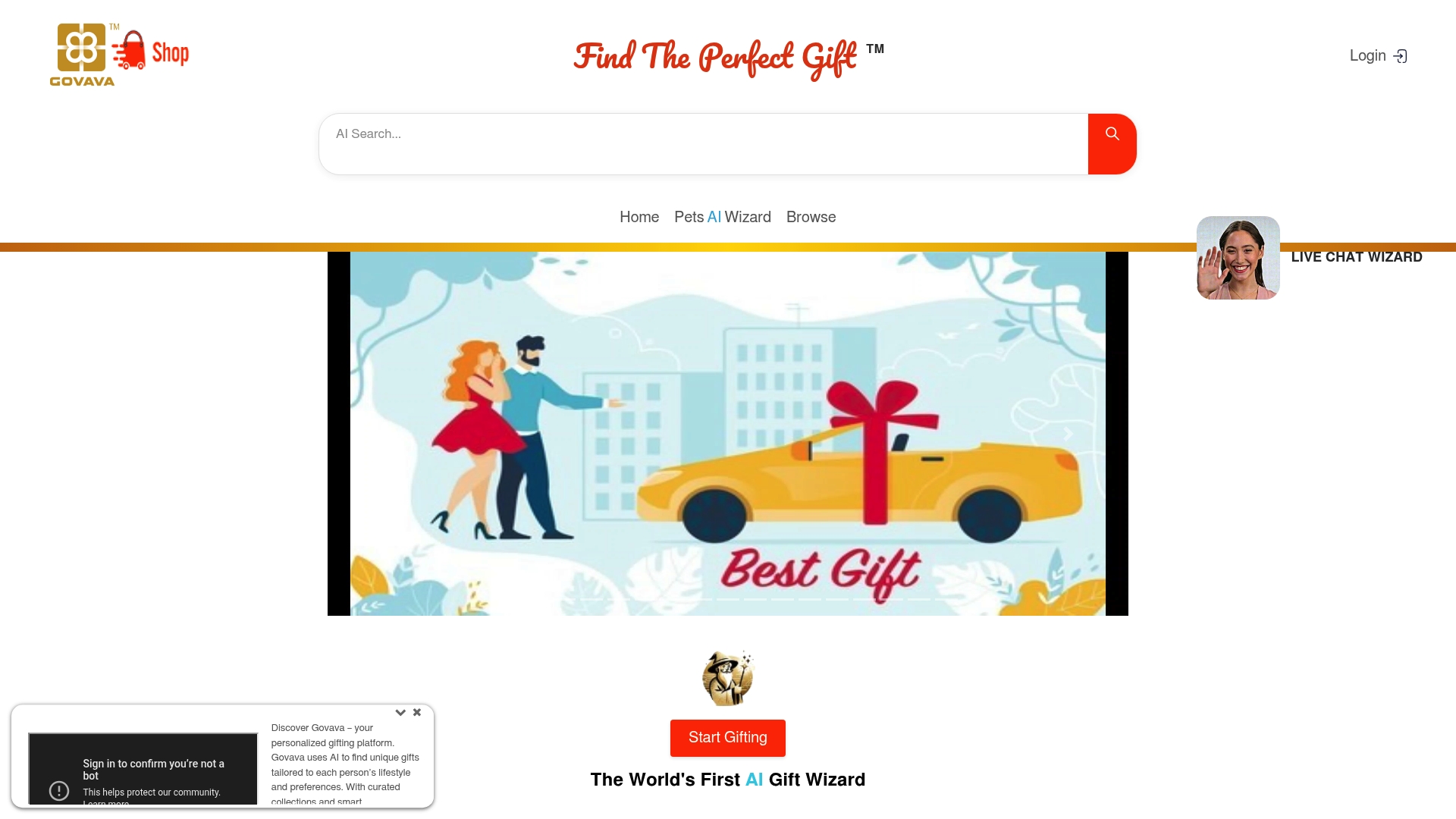
Whether you are shopping for a milestone birthday, a romantic anniversary, or a last-minute holiday gift, Govava's occasion-aware AI does the heavy lifting while you add the personal touches that make the gift feel like you. You can browse curated gift options matched to your occasion, or use Govava's AI gift search to filter by recipient, budget, and event type. The platform is built to make thoughtful gifting fast, personal, and genuinely satisfying for everyone involved.
FAQ
How does AI change recommendations based on the occasion?
Occasion input shifts the entire product category, price range, and emotional tone of AI gift suggestions. A birthday triggers different filters than an anniversary or graduation, because each occasion carries distinct social expectations and emotional weight.
What information does AI need for accurate gift recommendations?
The most useful inputs are occasion type, your relationship to the recipient, budget, and any known interests or hobbies. Structured inputs like occasion and budget are required by most AI gift engines to generate relevant, personalized results.
Can AI fully replace the personal effort in gift giving?
No. Outsourcing gift messages entirely to AI risks losing the relational meaning embedded in personal effort. AI excels at discovery and logistics, but the emotional depth of a gift still depends on your personal knowledge of the recipient.
How do I improve AI gift suggestions if the first results miss the mark?
Provide specific feedback on why the suggestions did not fit, such as noting the gifts felt too generic or not experiential enough. AI recommendations improve through iterative feedback rather than one-shot outputs, so corrections refine the next round significantly.
Does AI account for delivery timing when suggesting gifts?
Yes, occasion-aware AI factors in delivery urgency alongside product selection. For emotionally significant occasions like anniversaries, timely delivery expectations are built into the recommendation logic, filtering out options that cannot arrive in time.