

AI gift recommendation technology is defined as software that uses conversational inputs, behavioral data, and relationship context to generate personalized gift ideas matched to specific recipients, occasions, and budgets. For families juggling birthdays, holidays, graduations, and everything in between, this technology has swooped in like a trusty sidekick clad in binary code. Understanding how AI helps families find gifts means understanding one core truth: the best AI tools don't just search, they listen. According to Optimove's 2026 Mother's Day Shopping Report, 49% of U.S. shoppers regularly use AI tools for gift recommendations, with another 23% using them occasionally. That's a majority of shoppers trusting algorithms with one of the most emotionally loaded tasks in family life.
How AI helps families find gifts when shopping feels overwhelming
Gift shopping for a family is genuinely hard. You're not buying one thing for one person. You're buying a birthday present for your seven-year-old, a Father's Day gift for a dad who "doesn't need anything," and a teacher appreciation gift for someone you've met exactly twice. The emotional pressure is real, and the stakes feel higher than they should for what is, technically, just shopping.
The core problem families face is a combination of too many options and too little personal knowledge. You might know your mom loves gardening, but you don't know whether she already owns a Fiskars pruning set or whether she'd prefer an experience over a product. Traditional search engines return thousands of results and leave you to sort through the noise alone. That's exhausting, and it's why so many people default to gift cards.

AI gift finders address this differently. Conversational AI extracts multilayered intent from a single message, picking up on relationship cues, personality signals, and occasion context simultaneously. When you type "I need a gift for my dad who loves fishing but already has all the gear," a well-trained AI doesn't return a list of fishing rods. It pivots to fishing-adjacent experiences, personalized tackle storage, or custom apparel. That's the difference between a search engine and an intelligent gift assistant.
Here's what makes AI particularly good at this task:
- Layered intent parsing: AI reads between the lines of your description, not just the keywords.
- Relationship awareness: It adjusts suggestions based on whether you're shopping for a partner, a child, a parent, or a coworker.
- Budget filtering without forms: You mention a number in conversation and the AI calibrates without making you fill out a separate filter.
- Confidence building: Platforms like Alhena AI offer detailed product knowledge based on recipient profiles, so you feel informed before you buy.
Pro Tip: When you start a conversation with an AI gift tool, lead with the recipient's personality quirks, not just their hobbies. "She's the kind of person who organizes her spice rack alphabetically" tells an AI far more than "she likes cooking."
How AI personalizes gift ideas using relationship and occasion context
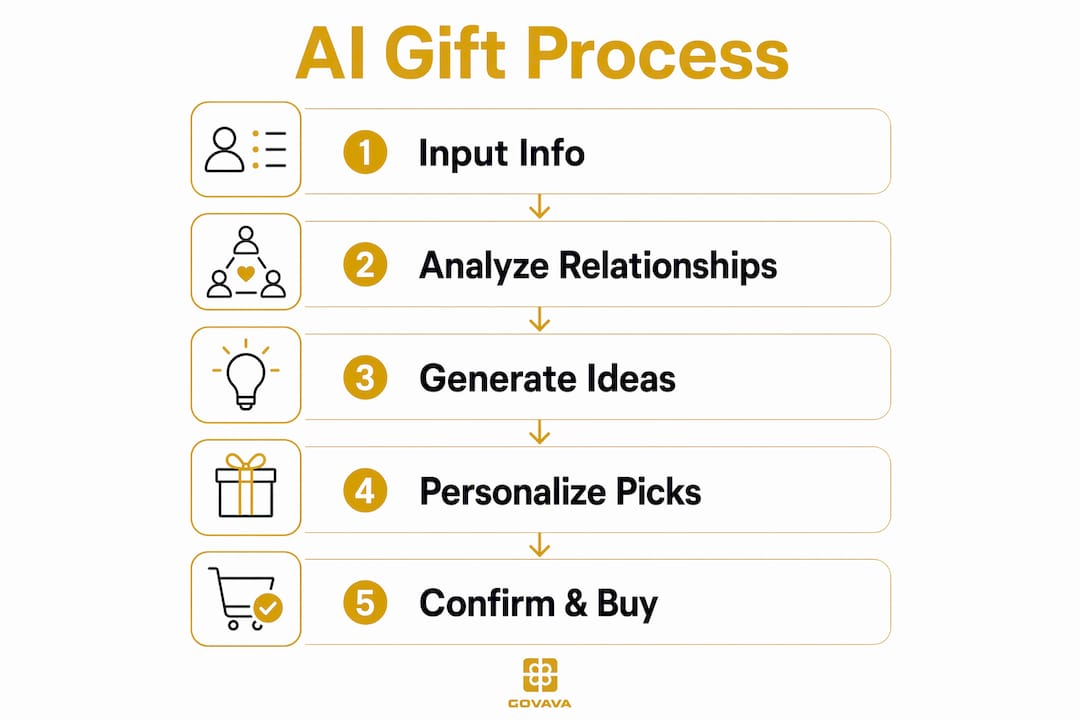
Personalization is where AI gift technology genuinely earns its place in the family shopping toolkit. The magic isn't in the catalog size. It's in how AI maps your inputs to emotional outcomes. Families don't just want gifts that are useful. Research from the National Retail Federation shows that 46% of families prioritize giving gifts that are "unique or different," and 37% want gifts that "create special memories." Those are emotional criteria, and AI is increasingly built to honor them.
Here's how a well-designed AI gift recommendation engine works through the personalization process:
- Relationship extraction: You mention "my son's kindergarten teacher" and the AI immediately calibrates tone, price range, and appropriateness. It knows this isn't a close personal relationship and adjusts accordingly.
- Occasion calibration: A birthday gift for a five-year-old carries different emotional weight than a retirement gift for a parent. AI reads the occasion and shifts its suggestions to match the emotional register.
- Interest and personality mapping: When you describe someone as "outdoorsy but not extreme, more of a weekend hiker," the AI filters out technical gear and surfaces lifestyle-oriented products that fit the vibe.
- Budget alignment: Rather than requiring a formal price filter, conversational AI absorbs budget cues from natural language and applies them silently throughout the recommendation process.
- Memory and uniqueness weighting: The best tools actively surface options that feel personal rather than generic, aligning recommendations to emotional values like uniqueness and special memories.
This is where AI and emotion genuinely dance together. The technology isn't replacing your instinct as a parent or partner. It's amplifying it, giving you options you wouldn't have found on your own and helping you articulate what you were already feeling. Platforms like Govava are built on exactly this principle, using personality, lifestyle, and relationship context to surface gifts that feel chosen, not generated. You can explore how this works in practice through AI personalization for families.
Comparing popular AI gift finder tools for families in 2026
Not all AI gift tools are built the same, and the differences matter when you're shopping for a diverse family with varied ages, interests, and occasions. Here's a clear-eyed look at how the leading options stack up.
| Tool | Personalization approach | Key family-friendly features | Limitation |
|---|---|---|---|
| Amazon Alexa for Shopping | Uses purchase history and browsing data | Comparison, scheduling, gift wrapping | Personalization resets outside Amazon ecosystem |
| Alhena AI | Conversational commerce from intent to checkout | Chat-to-cart flow, product expertise | Requires detailed input for best results |
| Govava | Personality, lifestyle, and relationship matching | Curated gift lists, occasion-based filtering | Newer platform, growing catalog |
| AI gift list tools (e.g., GiftList Genie) | Interest-based idea generation | Save and compare gift ideas over time | Less conversational, more catalog-style |
Amazon's Alexa for Shopping is the most integrated option for families already embedded in the Amazon ecosystem. It merges chatbot features with personalized recommendations drawn from your shopping history, turning the search bar into a genuine Q&A engine. The catch is that its personalization is strongest within Amazon's walls. Step outside that ecosystem and you're starting from scratch.
Alhena AI takes a different approach, focusing on conversational commerce that guides you from the first message all the way through to checkout inside a single chat interface. Zimply's collaboration with Svea Payments takes this further, enabling payment within AI chat sessions so families can complete a purchase without ever leaving the conversation. That kind of frictionless flow is genuinely useful when you're shopping on a phone between school pickups.
Pro Tip: If you use multiple AI gift tools across different retailers, keep a simple note on your phone with key details about each family member: age, top three interests, recent gifts received, and any strong dislikes. Paste this into each new AI chat to rebuild personalization quickly.
Practical tips to get the best results from AI gift assistants
Getting great AI gift recommendations is less about the tool and more about how you talk to it. Think of it like briefing a very smart personal shopper who has never met your family. The more specific and honest you are, the better the results.
The single most effective thing you can do is include constraints alongside interests. Effective AI gift finding requires inputs with constraints, context, and differentiators, not just a list of hobbies. "My husband likes cooking" is a starting point. "My husband likes cooking, we already own a KitchenAid stand mixer, his budget is around $75, and he tends to prefer practical over decorative" is a brief that produces genuinely useful results.
Here are the inputs that consistently improve AI gift recommendations for families:
- Recipient identity and relationship: Be specific. "My 10-year-old daughter" outperforms "a child."
- What they already own: This prevents duplicate suggestions and pushes AI toward genuinely new territory.
- Dislikes and dealbreakers: "She doesn't like anything too cutesy" saves you from a page of pastel-colored options.
- Occasion and emotional tone: A "just because" gift carries different energy than a milestone birthday. Say so.
- Delivery needs: Many AI tools support gift wrapping, personal messages, and delivery scheduling. Mention your timeline upfront so the AI can filter for what's actually achievable.
One important nuance: personalization resets when switching AI tools without data sharing between platforms. If you start on one platform and move to another, you're rebuilding context from zero. This is why families benefit from a dedicated AI gifting platform rather than hopping between retailer-specific tools. Govava's approach to family gift matching is designed with exactly this continuity in mind.
Pro Tip: After a successful AI gift recommendation, note what inputs produced the best results. Over time, you'll develop a personal briefing template that works across any AI tool you use.
How AI is reshaping gift-giving culture for modern families
The shift happening right now isn't just technological. It's cultural. Gift shopping used to be a transactional chore. You needed something, you found something, you bought it. AI is moving families toward outcome-oriented gifting, where the goal isn't just to check a box but to genuinely delight the recipient. That's a meaningful change in how families think about occasions.
AI adoption in gift shopping has normalized faster than most predicted. With nearly half of all shoppers now using AI tools regularly for gift ideas, the behavior is no longer niche. It's mainstream, and families with children are among the most motivated adopters because they face the highest volume of gifting occasions across the widest range of recipients.
The emotional payoff is real too. Reduced decision anxiety leads to better gift satisfaction, both for the giver and the recipient. When you feel confident in your choice because an intelligent system helped you think it through, the gift carries more meaning. It feels chosen rather than grabbed. And that emotional resonance is exactly what families say they want most.
"AI doesn't replace the love behind a gift. It removes the friction that gets in the way of expressing it."
The next frontier is omnichannel gifting, where AI connects online discovery with in-store pickup, same-day delivery, and personalized packaging in one continuous experience. Families who learn to use these tools well now will be ahead of the curve as the technology matures through 2026 and beyond.
Key takeaways
AI gift recommendation technology works best when families provide specific relationship context, constraints, and emotional priorities alongside basic interests.
| Point | Details |
|---|---|
| AI adoption is mainstream | Nearly half of U.S. shoppers now use AI tools regularly for gift recommendations. |
| Conversational input beats keyword search | Describing personality and constraints produces far better results than listing hobbies alone. |
| Ecosystem limits matter | Personalization resets when switching platforms, so a dedicated gifting tool outperforms retailer-specific AI. |
| Emotional criteria drive satisfaction | Families prioritize uniqueness and memory-making, and the best AI tools are built to reflect those values. |
| Outcome-oriented gifting is the new standard | AI shifts gift shopping from transactional to emotionally resonant, reducing decision anxiety for families. |
Why I think most families are still underusing AI for gifts
I've spent a lot of time watching how families actually interact with AI gift tools, and the pattern is consistent. Most people use AI the same way they use a search engine: they type a category and expect a list. They get mediocre results, shrug, and go back to Amazon's bestsellers. Then they wonder why the gift felt generic.
The families who get genuinely great results treat the AI like a conversation partner, not a search bar. They share context freely, they push back when suggestions miss the mark, and they use the AI's follow-up questions as prompts to think more carefully about the recipient. That's a different skill set, and it's one most people haven't been taught.
The other thing I've noticed is that inconsistent personalization across platforms frustrates people enough to give up. They get a great recommendation from one tool, switch to another for checkout convenience, and suddenly the magic is gone. The solution isn't to lower expectations. It's to choose a platform built for continuity, one where your family's preferences accumulate over time rather than evaporating with every session.
My honest advice: invest ten minutes in building a proper brief for each person you regularly buy gifts for. Treat it like a living document. Update it after each occasion. The AI does the heavy lifting, but you have to give it something real to work with. Families who do this consistently report that gift shopping stops feeling like a chore and starts feeling like something they're actually good at.
— carl
Find the perfect family gift with Govava's AI Gift Wizard
Govava is the AI gifting platform built specifically for the kind of gift-giving challenges families face every day, from the kindergarten teacher's end-of-year gift to the grandparent who has everything.
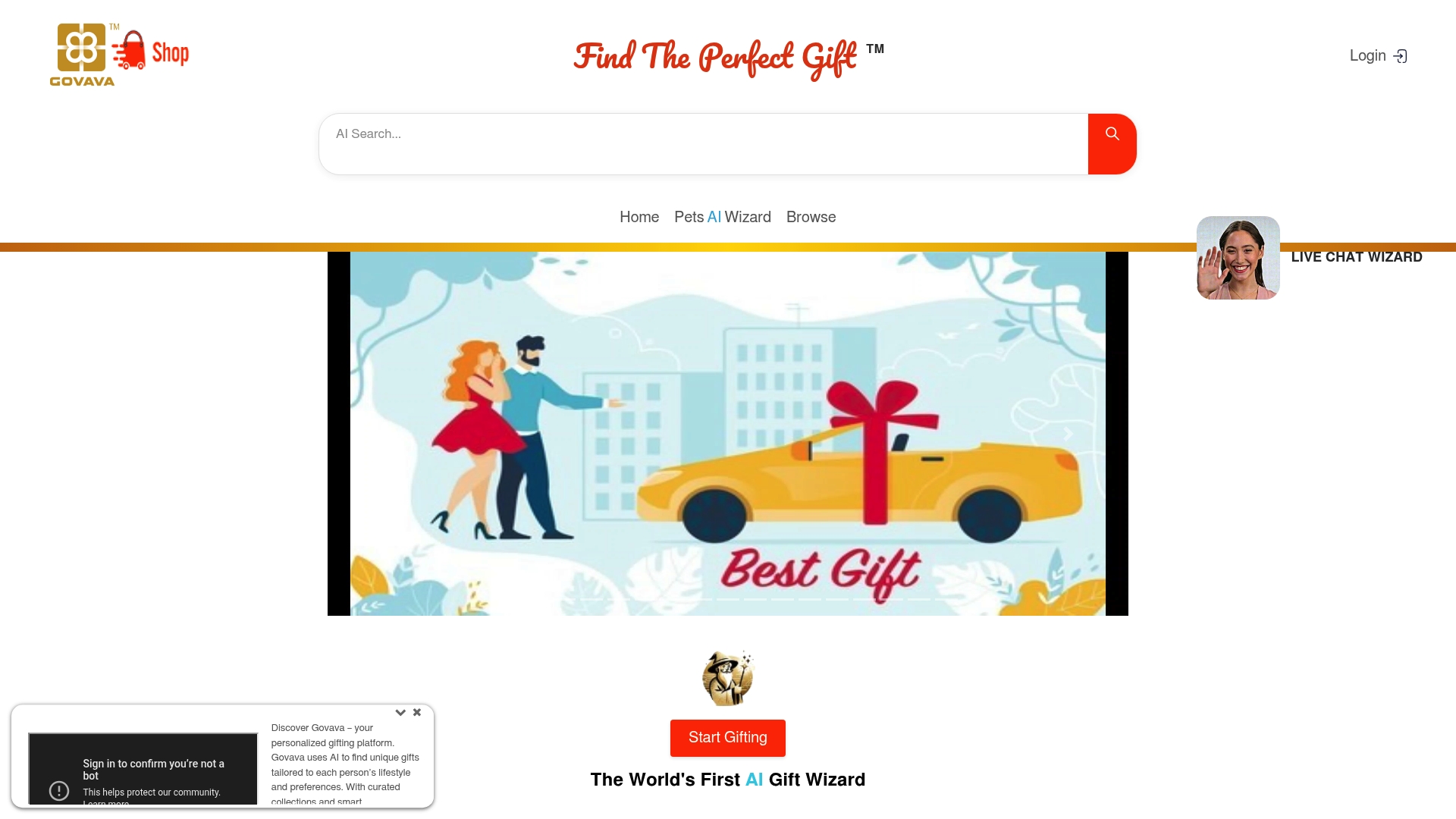
Govava's AI Gift Wizard learns the personalities, relationships, and occasions that matter to your family, then surfaces curated gift ideas that feel genuinely personal. Every recommendation comes with gift-ready wrapping options, personal message fields, and delivery scheduling so you can go from idea to doorstep without switching tabs. You can start with Govava's AI-powered gift search right now, or build out your family giftee list so every occasion is covered before it sneaks up on you.
FAQ
How does AI personalize gift recommendations for families?
AI gift tools extract relationship context, personality cues, interests, and budget from conversational inputs to generate tailored suggestions. Platforms like Govava layer in occasion context and emotional priorities like uniqueness and memory-making to refine results further.
What information should I give an AI gift finder?
Include the recipient's relationship to you, their top interests, what they already own, any dislikes, your budget, and the occasion. Specific constraints consistently produce better AI gift recommendations than broad interest categories alone.
Do AI gift tools work across different retailers?
Most AI gift tools personalize within their own ecosystem, and personalization resets when switching platforms. Using a dedicated AI gifting platform like Govava gives families continuity across sessions and occasions.
Can AI handle last-minute gift shopping for families?
Yes. Many AI gift tools support delivery scheduling and gift-ready packaging, and conversational AI can generate relevant ideas in seconds. The key is providing enough context upfront so the AI doesn't default to generic suggestions.
Are AI gift recommendations better than browsing bestseller lists?
AI gift recommendations outperform bestseller browsing because they filter by recipient-specific criteria rather than popularity. Conversational AI captures richer intent than static category filters, producing results that feel personal rather than mass-market.