

AI gift tools are personalized recommendation engines that replace hours of aimless browsing with instant, recipient-specific suggestions tailored to personality, occasion, and budget. If you've ever stared at a product page for twenty minutes and still walked away empty-handed, you already know the problem these tools solve. The industry term for this technology is "AI-powered gift recommendation systems," and platforms like Govava, Jenova's Shopping Advisor, Kohl's Gift Finder, and Macy's Ask Macy's are leading the charge. Understanding how AI gift tools save time starts with recognizing that the real enemy isn't a lack of options. It's decision fatigue.
How AI gift tools save time by cutting through decision fatigue
Decision fatigue is the real culprit behind gift shopping time loss, not a shortage of products. When you open a browser and search "birthday gift for mom," you're immediately confronted with thousands of results, zero context, and no filter for what your mom actually likes. That's where AI gifting solutions swoop in like a trusty sidekick clad in algorithmic precision.
The numbers tell a clear story. 40% of American shoppers cite not knowing what to buy as a major frustration, and 74% have received gifts they didn't like. That second statistic matters enormously: it means most traditional gift searches end in a result that disappoints the recipient, which wastes both the shopper's time and the gift-giver's goodwill.
"70% of online shoppers feel overwhelmed or uncertain during gift searches, with 62% continuing to browse endlessly rather than committing to a purchase."
That figure, drawn from Attentive's 2026 consumer survey of 1,050 shoppers, captures exactly why traditional browsing is such a time sink. AI tools break this cycle by narrowing the field immediately. Instead of showing you 500 candles, a well-built AI gift finder asks about the recipient's hobbies, lifestyle, and relationship to you, then surfaces five genuinely relevant options. That guided approach increases purchase likelihood by 73%, which means fewer abandoned searches and more confident decisions made in far less time.
The psychological mechanism here is worth understanding. AI collapses a complex, multi-step search and reassessment process into a guided conversation. You answer a few questions, the AI takes notes, and the result feels less like shopping and more like asking a well-informed friend for advice. For busy parents juggling school pickups and work deadlines, that shift from overwhelm to clarity is genuinely life-changing.

Which AI gift tools are worth your time?
Not all AI gifting solutions are built the same, and the differences in features directly affect how much time you actually save. Here's a practical comparison of the tools making the biggest impact right now.
| Tool | Key feature | Time-saving mechanism |
|---|---|---|
| Jenova's Shopping Advisor | Recipient-first input with persistent memory | Remembers past gifts to prevent repeats across sessions |
| Kohl's Gift Finder | Conversational AI with Google Cloud Gemini Enterprise | Browse, view products, and add to cart within one chat |
| Macy's Ask Macy's | Multimodal search and virtual try-on | Reduces back-and-forth product research visually |
| Kate Spade AI Gift Concierge | Agentic commerce with intent-based recommendations | Converts at 3.5× the rate of traditional keyword search |
Jenova's Shopping Advisor stands out for its recipient-first design philosophy. You describe the person you're buying for before you describe what you want to spend, which mirrors how thoughtful humans actually think about gifts. The tool's persistent memory across sessions means it remembers that you already gave your sister a spa kit last year, so it won't suggest another one this birthday.
Kohl's Gift Finder, powered by Google Cloud Gemini Enterprise, takes integration seriously. You can upload an image, browse suggestions, view product details, and add items to your cart without ever leaving the chat window. Macy's Ask Macy's went from beta to full rollout in just over five weeks, which signals how quickly retailers are moving to meet shopper demand for faster, guided experiences.
Kate Spade's AI Gift Concierge is perhaps the most telling example of what agentic commerce can do. By focusing on recipient intent rather than keyword matching, it converts shopping sessions at 3.5× the rate of traditional search. That's not just a marketing metric. It means shoppers are finding what they need and committing to it, rather than bouncing between tabs and second-guessing themselves.
Pro Tip: When testing any AI gift tool for the first time, describe the recipient's personality before their age or gender. Tools that prioritize personality inputs tend to surface more surprising and accurate suggestions than those that rely on demographic filters alone.
How integrated shopping flows multiply the time you save
Finding a great gift idea is only half the battle. The other half is actually buying it, and that's where most shoppers lose another chunk of time. Imagine this: you get a brilliant suggestion from an AI tool, then you open a new tab to search for the product, compare prices on another tab, check reviews on a third, and finally navigate to checkout on a fourth. That's four extra steps that didn't need to happen.
The best automated gift recommendation platforms eliminate this entirely. Kohl's Gift Finder allows shoppers to browse, view product details, and add items to their cart within a single chat interface, removing every unnecessary workflow switch. For a busy professional with fifteen minutes between meetings, that kind of friction reduction is the difference between a gift purchased and a gift forgotten.
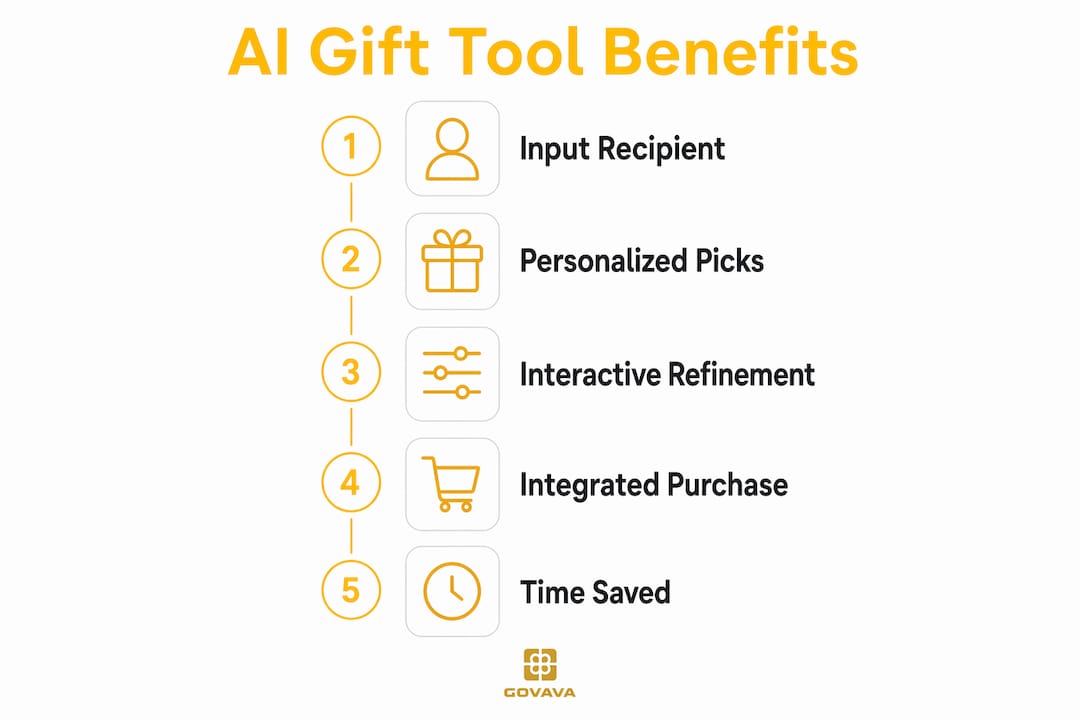
Here's what a fully integrated AI gift shopping flow looks like in practice:
- You describe the recipient and occasion in a chat window.
- The AI surfaces three to five curated options with images and prices.
- You tap to view details, read a brief description, and add your choice to the cart.
- You check out without ever leaving the interface.
That entire process can take under five minutes. Compare that to the average browsing session, where multiple browser tabs and manual filtering can stretch a simple purchase into a 45-minute ordeal. Agentic commerce architectures, like the one powering Kate Spade's concierge, go even further by orchestrating recommendation, image search, and cart updates simultaneously in the background. You see a clean, simple conversation. Behind the scenes, the AI is running multiple tasks at once so you don't have to.
Pro Tip: Look for AI gift tools that let you add items to your cart directly from the recommendation chat. If a tool sends you to a separate product page every time, you're losing most of the time savings it promises.
For a deeper look at how these tools fit into the broader retail AI picture, the role of AI in modern shopping has expanded dramatically in just the past two years, and understanding that context helps you choose the right platform for your needs.
Why interactive refinement is the biggest time-saver of all
Here's something most articles on this topic miss entirely: the biggest time-saver in AI gifting isn't the initial recommendation. It's what happens when the first suggestion doesn't quite fit.
With traditional search, a mismatch sends you back to square one. You retype your query, scroll through new results, and repeat the whole exhausting process. With a well-designed AI gift tool, you simply say "a bit more affordable" or "something more outdoorsy," and the tool adjusts instantly within the same session. Interactive refinement within sessions is the feature that prevents the most common failure mode in gift shopping: the abandoned search.
Think about how this plays out for a parent shopping for a teenager's birthday. The first round of suggestions might be slightly off. With interactive refinement, the parent can:
- Adjust the budget range without restarting the conversation.
- Shift the category from "tech gadgets" to "creative hobbies" with a single message.
- Specify that the teen already owns a particular item to avoid duplicates.
- Narrow down to options available for next-day delivery when time is tight.
Each of those adjustments takes seconds, not minutes. Jenova's Shopping Advisor handles this particularly well, using session memory to track what's been suggested and rejected, so it never circles back to an idea you've already dismissed. That kind of personalization through remembered preferences is what separates a genuinely useful AI tool from a glorified search bar.
The practical upshot for busy shoppers is significant. You're not starting over. You're refining. And that shift in mental model, from "searching" to "collaborating with an AI," is what makes the whole experience feel less like a chore and more like a conversation with someone who actually knows your family. For more on how this personalization works across different relationships, AI personalization for family gifting breaks down the mechanics in a way that's genuinely useful.
Key takeaways
AI gift tools save the most time when they combine personalized recommendations, interactive refinement, and integrated checkout in a single interface, eliminating both decision fatigue and workflow friction.
| Point | Details |
|---|---|
| Decision fatigue is the core problem | AI narrows thousands of options to a curated few, cutting browsing time dramatically. |
| Integrated checkout multiplies savings | Tools like Kohl's Gift Finder let you add to cart within the chat, removing extra steps. |
| Interactive refinement prevents restarts | Adjusting budget or category mid-session saves more time than the initial recommendation. |
| Persistent memory avoids duplicates | Tools like Jenova's Shopping Advisor remember past gifts so you never repeat yourself. |
| Agentic commerce raises the bar | Kate Spade's concierge converts at 3.5× traditional search by orchestrating tasks simultaneously. |
Why I think most people are still underusing these tools
I've watched the gifting space evolve for years, and the pattern I keep seeing is this: people try an AI gift tool once, get a decent suggestion, and then go back to their old habits the next time a birthday rolls around. That's a shame, because the real value of these tools compounds over time.
The first session with a tool like Govava or Jenova's Shopping Advisor is good. The fifth session, when the tool has learned your recipients' preferences and your gifting history, is genuinely impressive. Most shoppers never get there because they treat AI tools as a one-time shortcut rather than a long-term gifting companion.
There's also a tendency to use these tools only for difficult recipients, the colleague you barely know or the in-law with mysterious tastes. But the time savings are just as real for the people you know well. When you're buying a third birthday gift for your best friend in as many years, even a familiar recipient benefits from AI-assisted discovery of something fresh and unexpected.
What I'd tell any busy parent or professional is this: commit to using an AI gift tool for every gift over the next three months. Not just the hard ones. All of them. You'll build a gifting history the AI can learn from, you'll stop spending Sunday evenings scrolling through product pages, and you'll start giving gifts that people actually love. The real benefits of AI gift recommendations go well beyond convenience. They touch on the quality of your relationships.
— carl
Find your next perfect gift with Govava
Govava's AI Gift Wizard is built for exactly the kind of shopper this article is written for: busy, thoughtful, and completely done with endless browsing. You describe who you're shopping for, share a bit about their personality and interests, and Govava's recommendation engine gets to work, surfacing curated, emotionally resonant options in seconds.

The platform combines recipient-first personalization with an integrated shopping experience, so you move from idea to purchase without the usual tab-switching chaos. Whether you're shopping for a last-minute birthday or planning ahead for the holidays, Govava makes the process feel less like a task and more like a gift in itself. Start your AI gift search today and find something genuinely worth giving, in the time it takes to drink your morning coffee.
FAQ
How much time do AI gift tools actually save?
AI gift tools can reduce a typical gift search from 45 minutes of browsing to under five minutes by narrowing options instantly and integrating checkout within the same interface.
What makes AI gift recommendations more accurate than regular search?
AI gift finders use recipient-specific inputs like personality, hobbies, and past gifts rather than generic keywords, which is why purchase likelihood increases by 73% compared to traditional browsing.
Can AI gift tools remember what I've already given someone?
Yes. Tools like Jenova's Shopping Advisor use persistent memory to track gift histories across sessions, preventing duplicate suggestions and refining recommendations over time.
What is agentic commerce in the context of gift shopping?
Agentic commerce refers to AI systems that handle multiple tasks simultaneously, such as recommendation, product search, and cart updates, within a single conversation, as seen in Kate Spade's AI Gift Concierge.
Are AI gift tools useful for last-minute shopping?
Absolutely. Because these tools surface relevant options in seconds and often include filters for delivery speed, they are particularly well-suited to last-minute gift searches where time is the primary constraint.